Bambu Lab H3C Review: 9-Tool Swaptek & AMS 3H Specs
PrintStack3D · 2026-11-03
From Single-Nozzle Purging to a 9-Head Industrial Toolchanger
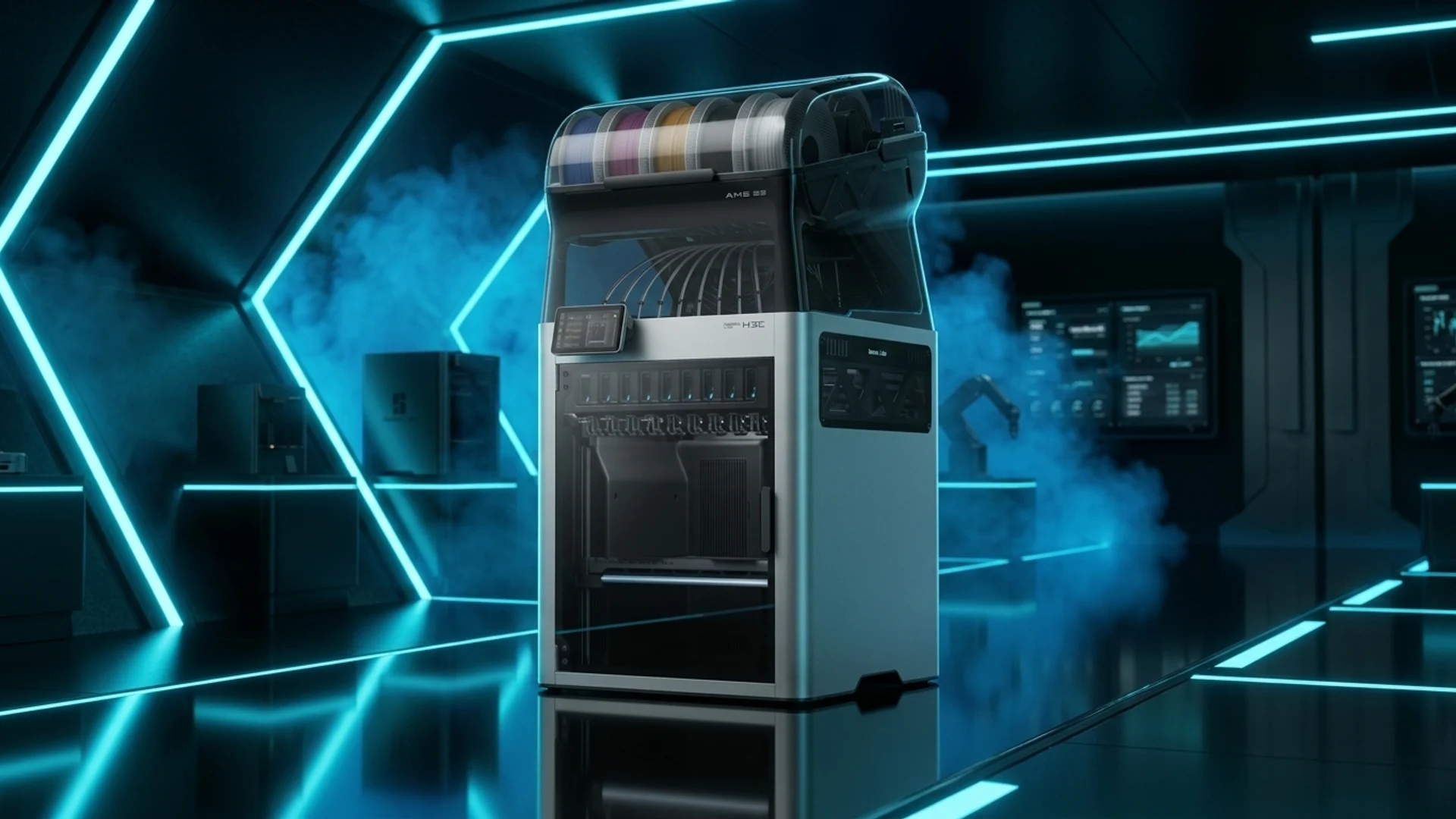
On November 3, 2026, Bambu Lab officially unveiled its most ambitious additive manufacturing system to date: the Bambu Lab H3C. While the first-generation X1 and P1 series mainstreamed multi-color printing via single-nozzle filament swapping, and the Bambu Lab H2 series (H2C / H2D / H2S) pioneered inductive nozzle swapping, the H3C makes the definitive leap into true 9-tool multi-material toolchanging.
For mechanical engineers, product designers, and on-demand manufacturing bureaus, the H3C solves the three biggest bottlenecks in FFF/FDM multi-material production:
- Elimination of 60-Second Purge Cycles: All 9 PrintTools remain permanently loaded with filament right down to the melt zone, switching tools in under 6 seconds.
- True Dissimilar Polymer Bonding with Zero Cross-Contamination: Combine rigid carbon-fiber PA-CF / PETG-CF with ultra-soft Shore 75A TPU and dedicated breakaway support filaments without residual polymer contamination inside a shared nozzle weakening Z-axis layer adhesion.
- Mixed Nozzle Diameters Within a Single Build: Pair a
0.2 mmprecision nozzle for razor-sharp serial numbers and locator bores alongside a0.8 mmhigh-flow nozzle for rapid structural walls in the exact same print job.
Need this printed? Get an instant price for your model — upload it in the configurator with a free account.
Complete Technical Specifications: Bambu Lab H3C (2026)
Below is the verified specification sheet for engineering and procurement teams evaluating the H3C platform:
| Specification | Bambu Lab H3C (with Integrated AMS 3H) |
|---|---|
| Motion & Tool Architecture | CoreXY with Swaptek™ 9-Tool Changer |
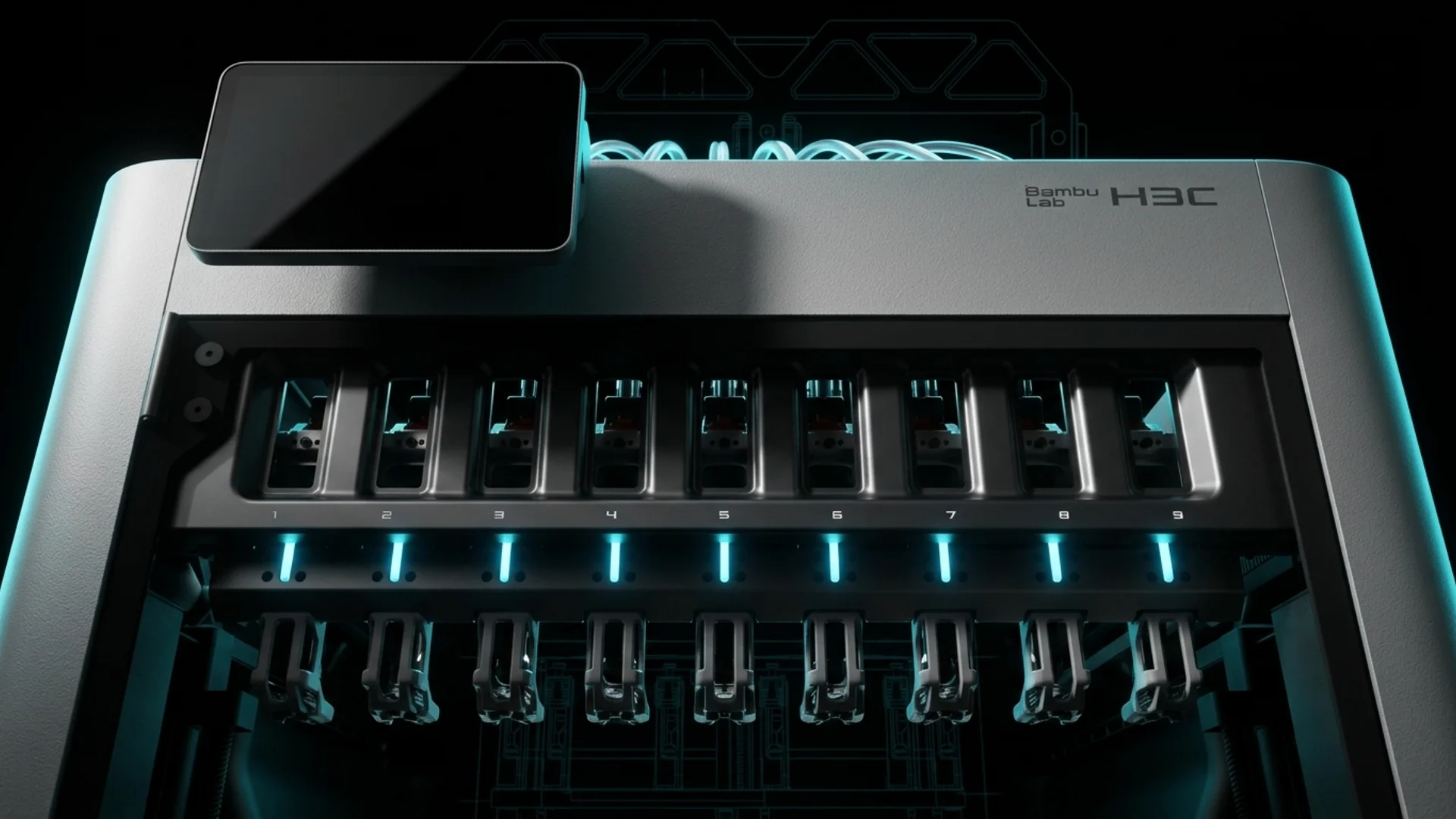
| Independent PrintTools | 9 Hardwired PrintTools (housed on a drop-down front rack) |
| Tool Swap Time | Under 6 seconds (with active predictive preheating) |
| Build Volume (W × D × H) | 330 × 320 × 325 mm |
| Maximum Toolhead Speed | 1,400 mm/s |
| Maximum Acceleration | 25,000 mm/s² |
| Max Hotend Temperature | 350 °C (Hardened steel HRC 55+ nozzles & gears standard) |
| Max Volumetric Flow Rate | 40 mm³/s |
| Supported Nozzle Sizes | 0.2 mm / 0.4 mm / 0.6 mm / 0.8 mm (mixable within one print job) |
| Filament Diameter (FlexFeed) | 1.75 mm standard + 2.85 mm bypass (engineered for Shore 75A TPU) |
| Max Heated Bed Temperature | 120 °C |
| Active Chamber Heating | Up to 65 °C (fully enclosed thermal build chamber) |
| Filament Management & Drying | Top-mounted AMS 3H (9 spools total, 2-slot active drying chamber up to 85 °C + 7 sealed bays) |
| Machine Dimensions & Weight | 493 × 571 × 1,016 mm · approx. 36.28 kg (including AMS 3H) |
| Launch Price (H3C AMS Combo) | €2,499 EUR (incl. VAT) / $2,499 USD / £2,199 GBP |
Inside the Swaptek™ 9-Tool Architecture
At the core of the Bambu Lab H3C is the Swaptek™ tool-changing mechanism. Mounted across the upper front of the build chamber is a motorized drop-down rack housing nine compact, individually hardwired PrintTools.
            [ AMS 3H: 9 Spool Capacity (2 Active 85 °C Drying Slots: T6 & T8) ]
                │    │    │    │    │    │    │    │    │
                ▼    ▼    ▼    ▼    ▼    ▼    ▼    ▼    ▼  (9 Dedicated PTFE Paths)
┌───────────────────────────────────────────────────────────────────────┐
│  Swaptek™ Rack: [T1] [T2] [T3] [T4] [T5] [T6] [T7] [T8] [T9]          │
│                 0.2  0.4  0.4  0.4  0.6  0.8  TPU  SUP  CF            │
└───────────────────────────────────┬───────────────────────────────────┘
                                    │  ◄── Tool swap in < 6 seconds
                                    ▼      (Predictively preheated)
                     [ Active CoreXY Motion Carriage (1,400 mm/s) ]
1. Sub-6-Second Swaps via Predictive Preheating
On a traditional single-nozzle multi-color system, every filament change requires cutting the filament, retracting it dozens of centimeters back to the spool holder, feeding the new spool forward, heating, and flushing the old color out of the melt chamber—costing 45 to 90 seconds per swap.
On the H3C, each of the 9 filaments stays loaded inside its own dedicated PrintTool (complete with its own filament path, cutter, heater block, and HRC 55+ nozzle). Looking ahead in the G-code, the motion controller activates predictive preheating on the next scheduled PrintTool while the active tool finishes its current perimeter. The carriage docks the current tool, locks onto the pre-heated replacement tool, and resumes extrusion in under 6 seconds.
2. Zero Nozzle Cross-Contamination Between Engineering Polymers
Anyone who has printed a structural PETG or PA-CF component using a dissimilar breakaway support filament in a single nozzle knows the structural risk: trace amounts of the release polymer lingering inside the nozzle walls contaminate the structural filament, causing delamination under mechanical load.
Because every PrintTool on the H3C is physically isolated, a tool dedicated to PETG-CF never touches PLA, PVA, or TPU. This preserves 100% pure interlayer fusion on multi-material functional parts.
Game-Changer for DFM: Mixing 0.2 mm and 0.8 mm Nozzles in One Job
One of the highest-ROI capabilities of the H3C for industrial production is mixing different nozzle diameters within the same print job.
Previously, engineers faced a strict compromise between surface resolution and build speed:
- A 0.2 mm nozzle resolves ultra-crisp embossed text, fine knurling, and miniature gear teeth, but takes days to print a 300 mm housing.
- A 0.6 mm or 0.8 mm nozzle deposits thick, high-strength structural walls and gyroid infill at volumetric rates up to 40 mm³/s, but rounds off sharp corners and fine features.
With the Bambu Lab H3C, our slicing pipeline assigns PrintTool #1 (0.2 mm nozzle) to exterior cosmetic legends and tight-tolerance bearing fits, while PrintTool #2 (0.6 mm or 0.8 mm hardened steel nozzle) blasts through internal perimeters and structural infill. You achieve 0.2 mm exterior resolution at 0.8 mm production speed.
FlexFeed Extruder: Why 2.85 mm Unlocks Ultra-Soft Shore 75A TPU
A standout engineering detail on the H3C is the FlexFeed extruder architecture, which accommodates both standard 1.75 mm filament and 2.85 mm filament via a dedicated bypass feed. Why did Bambu Lab introduce 2.85 mm capability specifically for elastomers?
The physics comes down to Euler column buckling:
- Standard flexible filament like TPU Shore 95A has the firmness of a skateboard wheel and feeds reliably at 1.75 mm diameter.
- Ultra-soft Shore 75A TPU (squishy like a gel shoe midsole or soft silicone gasket) behaves like wet spaghetti at 1.75 mm diameter: as soon as extruder drive gears push it against nozzle backpressure, the thin filament buckles and jams.
- Stepping the filament diameter up to 2.85 mm increases cross-sectional column stiffness (area moment of inertia) by roughly 7×. This allows the H3C to print ultra-soft Shore 75A TPU reliably alongside firmer 90A/95A TPU and rigid carbon-fiber composites in a single automated build.
This unlocks immediate industrial applications:
- Multi-Durometer Robotics End-of-Arm Tooling (EOAT): Co-print a rigid carbon-fiber ISO mounting flange, a medium-flex TPU-95A compliant joint, and an ultra-soft TPU-75A high-friction fingertip pad for handling delicate optics or glassware.
- Weatherproof Electronics Enclosures: Print a rigid PETG-CF or ASA enclosure with a soft, compressible Shore 75A perimeter gasket and tactile membrane buttons co-printed directly in place. See our electronics enclosure DfAM guide.
- Custom Ergonomics & Footwear: Produce variable-density cushioning lattices, medical orthotics, and vibration-damping industrial grips.
AMS 3H: The Integrated '9-Car Garage' with Dual-Slot 85 °C Active Drying
Unlike previous AMS units that sat beside the printer as optional accessories, the AMS 3H bolts directly onto the top of the H3C as an integrated, sealed filament bay:
- Direct Gravity-Assisted 9-Spool Feeding: Housing 9 spools side-by-side directly above the tool rack keeps individual PTFE feed tubes short and straight, minimizing friction drag during 1,400 mm/s travel moves.
- Targeted Active Drying up to 85 °C (Slots 6 & 8): Engineering polymers like Nylon (PA-CF), Polycarbonate (PC), and TPU are notoriously hygroscopic. Rather than heating all 9 spools simultaneously (which risks heat creep and softening low-Tg materials like PLA), the AMS 3H isolates active heating to a specialized 2-slot drying chamber (slots 6 and 8) that reaches 85 °C with active convection, keeping technical filaments bone-dry during multi-day production runs.
- Hermetic Desiccant Bays for the Remaining 7 Slots: The other 7 spool positions remain hermetically sealed with desiccant chambers and independent temperature/humidity sensors to prevent moisture uptake without heat.
- Legacy AMS Chaining up to 24 Spools: While the 9-tool Swaptek rack is the fastest zero-purge mode, the H3C retains compatibility with daisy-chained AMS units for projects requiring up to 24 distinct colors.
Benchmark Comparison: Bambu Lab H3C vs. H2C vs. Prusa XL vs. X1E
How does the Bambu Lab H3C stack up against current multi-tool and industrial desktop platforms?
| Feature / Metric | Bambu Lab H3C (New) | Bambu Lab H2C | Prusa XL (5-Tool) | Bambu Lab X1E / P1S |
|---|---|---|---|---|
| Multi-Material System | Swaptek™ (9 PrintTools) | Vortek (7 Induction Nozzles) | 5 Independent Toolheads | 1 Nozzle + AMS Filament Swap |
| Tool Switch Time | < 6 seconds | ~ 3 – 5 seconds | ~ 6 – 8 seconds | 45 – 90 seconds |
| Build Volume | 330 × 320 × 325 mm | 330 × 320 × 325 mm | 360 × 360 × 360 mm | 256 × 256 × 256 mm |
| Max Speed | 1,400 mm/s | 1,000 mm/s | ~ 400 mm/s | 500 mm/s |
| Active Chamber Heat | Yes, up to 65 °C | Yes, up to 80 °C | Optional passive enclosure | Yes, up to 60 °C (X1E) |
| Integrated Drying | Yes, AMS 3H (2 active 85 °C bays + 7 sealed) | External AMS HT | No (Requires external dryboxes) | No |
| Ultra-Soft TPU (75A) | Yes (1.75 & 2.85 mm FlexFeed) | Limited (1.75 mm) | Yes (Direct drive) | Not supported via AMS |
What the Bambu Lab H3C Means for PrintStack3D Customers
At PrintStack3D, we continuously upgrade our automated print farm in the Netherlands with flagship Bambu Lab hardware. The release of the H3C brings three direct benefits to your orders:
- Lower Cost & Faster Turnaround on Multi-Color Parts: Eliminating 60-second purge cycles and massive prime towers slashes machine time on control panels, architectural scale models, and branded Print on Demand e-commerce products.
- Flawless Overhangs on Complex Engineering Geometry: With 9 dedicated PrintTools, keeping breakaway or soluble support-interface materials permanently loaded ensures clean, scar-free mating surfaces on custom manufacturing jigs and fixtures.
- True Multi-Durometer Assemblies: Combining rigid carbon-fiber housings with soft Shore 75A/95A elastomer seals and grips in a single print job eliminates manual gluing and secondary assembly steps.
Quote Your Multi-Material or Large-Format Part Today
Have a multi-body 3MF or STEP assembly ready for production? Upload your files to our instant online quoting calculator to configure materials, colors, and quantities in seconds, or contact our engineering services team for custom multi-material production advice.
Explore our technical filament specifications or use our interactive filament advisor to select the right polymer for your application.
Upload your 3MF, STEP, or STL file for an instant online quote →
Frequently Asked Questions
What is the Bambu Lab H3C and how does its Swaptek system work?
Released on November 3, 2026, the Bambu Lab H3C is Bambu Lab's third-generation flagship 3D printer featuring a true multi-toolchanger architecture called Swaptek. Instead of retracting and purging filaments through a single nozzle, the H3C houses 9 independent, pre-loaded PrintTools on a drop-down front rack and swaps between them in under 6 seconds.
What are the full technical specifications of the Bambu Lab H3C?
The Bambu Lab H3C features a 330 × 320 × 325 mm build volume, 1,400 mm/s maximum toolhead speed, 25,000 mm/s² acceleration, 350 °C hardened steel nozzles (HRC 55+ standard across all 9 tools), a 120 °C heated bed, 65 °C active chamber heating, and up to 40 mm³/s volumetric flow.
What is the new AMS 3H system included with the Bambu Lab H3C?
The AMS 3H is a top-mounted, sealed '9-car garage' filament management unit that bolts directly onto the H3C. It houses 9 spools feeding all 9 PrintTools simultaneously, reads RFID spool profiles automatically, and features a dedicated dual-slot active drying chamber (slots 6 and 8) reaching up to 85 °C for hygroscopic engineering materials like PA-CF, PC, and TPU, alongside 7 sealed desiccant-assisted feeder bays.
Can the Bambu Lab H3C mix different nozzle diameters and ultra-soft Shore 75A TPU in one print?
Yes. Because each of the 9 PrintTools has its own dedicated hotend, you can combine a fine 0.2 mm nozzle (for crisp text and micro-features) with a 0.6 mm or 0.8 mm nozzle (for high-speed structural walls and infill) in a single print job. Additionally, the FlexFeed extruder supports both 1.75 mm and 2.85 mm filament paths to print ultra-soft Shore 75A TPU without buckling.
How much does the Bambu Lab H3C cost in Europe, the US, and the UK?
The Bambu Lab H3C AMS Combo (which includes the H3C printer, the top-mounted AMS 3H unit, and all 9 PrintTools) launches at €2,499 incl. VAT in the EU, $2,499 USD excl. tax in the US, and £2,199 GBP in the UK.
How does the Bambu Lab H3C (Swaptek) differ from the H2C (Vortek)?
While the H2C introduced the Vortek inductive nozzle-swapping mechanism (up to 7 nozzles sharing an extruder path), the H3C leaps to 9 completely independent PrintTools—each with its own dedicated filament path, internal cutter, and predictive preheater. This eliminates filament retraction cycles entirely and unlocks multi-durometer flexible TPU printing.