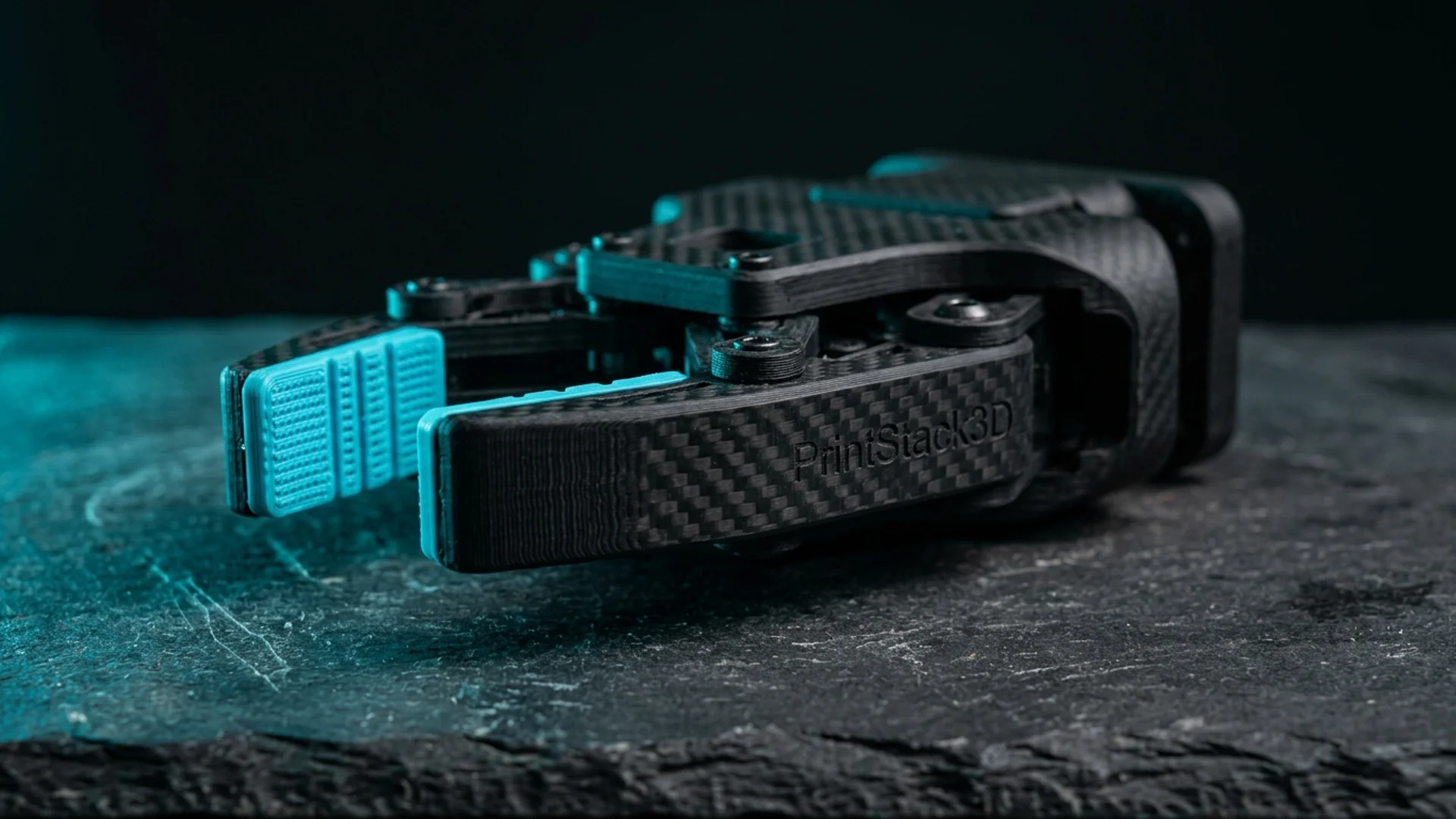
3D Printing for Robotics: Grippers & End-of-Arm Tooling
PrintStack3D · 2026-10-01
The Critical Impact of Tool Weight at the Robot Wrist
In industrial automation and robotics, the tool mounted at the end of the robot arm—known as End-of-Arm Tooling (EOAT)—dictates application speed, accuracy, and efficiency. Whether in high-speed pick-and-place cells, automated packaging lines, or collaborative robotics (such as Universal Robots, Fanuc CRX, or ABB GoFa), every gram at the robot wrist impacts overall system performance.
Historically, custom grippers were milled from solid aluminum billets (typically 6061 or 7075). While aluminum offers high strength, it introduces severe engineering drawbacks:
- Inertia and Resonance: Heavy metal end effectors increase the rotational moment of inertia during rapid accelerations, leading to arm oscillation and extended settling times.
- Payload Penalty: A collaborative robot with a 5 kg rated payload losing 2 kg to a bulky aluminum gripper retains only 3 kg for the actual workpiece.
- Costly Prototyping Iterations: Modifying a CNC-machined gripper finger requires days or weeks of machine shop scheduling at significant hourly machining rates.
- Part Scratching and Rejection: Rigid metallic surfaces contacting delicate components (glass, polished plastics, painted enclosures) cause cosmetic blemishes and part scrap.
In 2026, industrial additive manufacturing has become the primary production standard for lightweight, optimized EOAT systems.
Need this printed? Get an instant price for your model — upload it in the configurator with a free account.
Why Additive Manufacturing Excels in Robotics Tooling
| Aspect | Machined aluminum EOAT | 3D-printed EOAT |
|---|---|---|
| Weight & inertia | Heavy metal end effectors raise rotational inertia — arm oscillation and longer settling times | Up to 70% lighter with gyroid or hexagonal infill — aggressive acceleration within motor torque limits |
| Usable payload | A 5 kg cobot losing 2 kg to the gripper keeps only 3 kg for the workpiece | Reduced inertia enables higher acceleration, faster cycle times and greater usable payload capacity |
| Iteration speed | Revising a CNC-machined finger takes days or weeks of machine shop scheduling | CAD revised and reprinted overnight — ready to test in 24 hours |
| Part handling | Rigid metal scratches glass, polished plastics and painted enclosures | Soft, high-friction TPU contact surfaces grip delicate components scratch-free |
Transitioning from subtractive machining to 3D printing provides automation engineers with four decisive mechanical advantages:
1. Dramatic Weight Reduction (Up to 70% Lighter)
By utilizing bionic infill structures (such as gyroid or hexagonal geometries), gripper housings can be kept hollow where internal shear stresses are minimal. Structural rigidity is retained while overall mass drops drastically. The robot can accelerate aggressively without exceeding motor torque limits.
2. Integrated Internal Pneumatics and Vacuum Manifolds
With industrial FDM printing, airtight pneumatic channels can be routed directly within the solid tool body. Bulky exterior pneumatic hoses, elbows, and push-in fittings around the robot wrist are completely eliminated, preventing snag hazards against safety enclosures or fixtures.
3. Rapid Iterative Prototyping (Tested in 24 Hours)
If a newly manufactured workpiece does not seat firmly in the gripper jaws, the CAD geometry can be revised and reprinted overnight, arriving ready for testing on the assembly line the following morning.
4. Hybrid Multi-Material Gripping
Combining rigid composite filaments with elastomeric polymers produces a single assembly with a rigid mounting flange and soft, high-friction gripping surfaces. How toolchanger printers handle multi-material jobs is covered in our Bambu Lab H3C toolchanger review.
The Optimal Material Pairing for Robotic Grippers
| Material | Properties | Typical use |
|---|---|---|
| PETG-CF & PA-CF | High tensile modulus, resists creep under constant clamping forces, precise repeatability | Gripper manifolds and structural bodies on ISO robot tool flanges |
| TPU (Shore 95A / 85A) | Virtually unbreakable, resistant to lubricants and cleaning agents, high friction | Vacuum cup adapters, soft gripper fingertips and locator nests |
| ESD-safe filaments | Static-dissipative, surface resistivity 10⁶ to 10⁹ Ω/sq | Pick-and-place handling semiconductors and PCB assemblies |
PrintStack3D recommends a layered engineering approach for high-performance EOAT components:
[ ISO Robot Flange ]
        │
        ▼ (PA-CF / PETG-CF: Extreme rigidity & geometric stability)
[ Gripper Manifold with Integrated Air Passages ]
        │
        ▼ (TPU Shore 95A: Damping, non-marking, high friction)
[ Gripper Jaw Contact Insert ] ──► [ Handled Workpiece ]
PETG-CF & PA-CF (Carbon Fiber Composites)
Chopped carbon fiber reinforcement substantially increases tensile modulus and resists creep under continuous clamping forces. These materials do not deform when clamping heavy components and ensure precise repeatability on standard ISO robot tool flanges.
TPU (Thermoplastic Polyurethane, Shore 95A / 85A)
TPU is virtually unbreakable, highly resistant to lubricants and cleaning agents, and exhibits a high coefficient of friction. It is ideal for vacuum cup adapters, soft gripper fingertips, and locator nests that must securely grip smooth products without slipping or marring.
ESD-Safe Technical Filaments
For pick-and-place lines handling semiconductors and PCB assemblies, we print grippers in static-dissipative polymers (surface resistivity 10⁶ to 10⁹ Ω/sq) to eliminate the risk of electrostatic discharge damage.
Proven 3D-Printed EOAT Use Cases
In factories and logistics centers, 3D-printed robotics components deliver daily reliability across numerous applications:
- Custom Vacuum Spiders: Multi-cup manifolds engineered precisely to match the complex 3D curvature of automotive windscreens, bottles, or stamped sheet metal.
- Conformal Parallel Gripper Jaws: Fingers with negative product contours that nest workpieces securely using minimal clamping pressure.
- Machine Vision & Sensor Mounts: Vibration-damped brackets for inspection cameras, laser line sensors, and inductive proximity switches mounted directly on the robot wrist.
- Articulated Cable Management: Custom dresspack saddles and clamps that organize power, data, and pneumatic feeds neatly along robot joints without pinching.
The same approach works away from the robot too: 3D printed jigs and fixtures for assembly and inspection.
Design Guidelines for Reliable 3D-Printed Grippers
When preparing EOAT components for additive manufacturing, follow these structural rules:
- Use Heat-Set Brass Inserts: Never thread bolts directly into printed polymer when parts undergo regular maintenance. Use ultrasonic or heat-set brass threaded inserts for durable fastening.
- Align Layers with Clamping Loads: Orient the print so that clamping loads act parallel to print layers rather than in tension across layer boundaries, preventing interlaminar shear.
- Generous Fillets at the Flange: Apply large internal fillets (R ≥ 3 mm) at the junction between the mounting flange and the extension arm to eliminate stress concentrations.
Accelerate Your Robotics Automation with PrintStack3D
Need custom gripper fingers, vacuum manifolds, or cobot mounting fixtures for your production line? PrintStack3D delivers precision robotics components with rapid European fulfillment.
Explore our industrial engineering services or read more technical guides on our blog. For recurring gripper or tooling runs, see our production for robotics and tooling.
Upload your CAD files and order custom robotics tooling online →
Frequently Asked Questions
Why do engineers choose 3D-printed robot grippers over CNC-machined aluminum?
3D-printed polymer and carbon-fiber EOAT parts are 60% to 70% lighter than aluminum. This reduces robot arm inertia, enabling higher acceleration, faster cycle times, and greater usable payload capacity.
Which materials are best suited for End-of-Arm Tooling?
PETG-CF and PA-CF (carbon fiber nylon) for structural rigidity and dimensional stability, combined with flexible TPU (Shore 95A) for conformal gripper fingers that handle delicate components scratch-free.
Can pneumatic and vacuum channels be integrated directly into the 3D-printed tool?
Yes. Additive manufacturing enables internal, airtight pneumatic channels routed directly inside the body, eliminating external tubing, fittings, and leak risks around the robot wrist.
What is the typical turnaround time for custom EOAT parts at PrintStack3D?
Custom EOAT brackets and gripper jaws are manufactured on our automated production farm and typically dispatched within 24 to 48 hours.