TPU 3D Printing: Flexible Wearables & Custom Insoles
PrintStack3D · 2026-06-13
The Rise of Flexible Polymers
Most 3D printed objects are rigid, durable plastic parts. However, the human body is not rigid, and the objects we wear shouldn't be either. Enter TPU (Thermoplastic Polyurethane), a rubber-like elastomer that bridges the gap between plastic and rubber.
From shock-absorbing phone cases and durable watch bands to custom orthopedic insoles, TPU has become the go-to material for functional wearables. Designing with flexible filaments, however, requires a completely different approach compared to printing rigid plastics like PLA.
Need this printed? Get an instant price for your model — upload it in the configurator with a free account.
Understanding Shore Hardness
Before buying TPU, you must choose its Shore hardness, which measures a material's resistance to indentation. For 3D printing filaments, this is measured on the Shore A scale:
| Shore hardness | Feel | Print difficulty | Best for |
|---|---|---|---|
| 95A | Firm, phone-case-like | Easy | Structural wearables |
| 85A–90A | Shoe-sole rubber | Needs precise tuning | Grips, insoles |
| 80A | Rubber-band soft | Hard — direct-drive only | Seals, cushions |
Pro Tip: You can control the perceived flexibility of a part by adjusting the infill density and wall count. A 95A TPU part printed with 10% Gyroid infill and 2 walls will feel much softer than the same part printed with 40% infill and 4 walls.
4 Keys to Successful TPU Printing
TPU's flexibility makes it notoriously difficult to feed through standard 3D printer extruders. Follow these settings for reliable results:
1. Use a Direct-Drive Extruder
In a Bowden extruder, the filament is pushed through a long PTFE tube. Because TPU is flexible, it behaves like a wet noodle, buckling and kinking inside the tube. A direct-drive extruder, where the drive gears sit directly above the hotend, is highly recommended for TPU.
2. Slow Down the Print Speed
Because TPU is elastic, fast printing builds up pressure in the nozzle, leading to inconsistent extrusion. Keep your print speeds between 15 and 35 mm/s, especially for softer grades.
3. Dry the Filament (Crucial)
TPU is extremely hygroscopic, meaning it absorbs moisture from the air like a sponge. Wet TPU bubbles in the nozzle, causes severe stringing, and creates weak layer bonds. Always dry your TPU at 55 °C for 6 hours before printing, or print directly from a heated dry box.
4. Optimize Retraction Settings
Minimize or turn off retraction. Rapidly retracting flexible filament can pull it out of alignment in the extruder gears, leading to jams. Instead, use a "wipe" path in your slicer to clean the nozzle end between moves.
Designing Custom Orthopedic Insoles
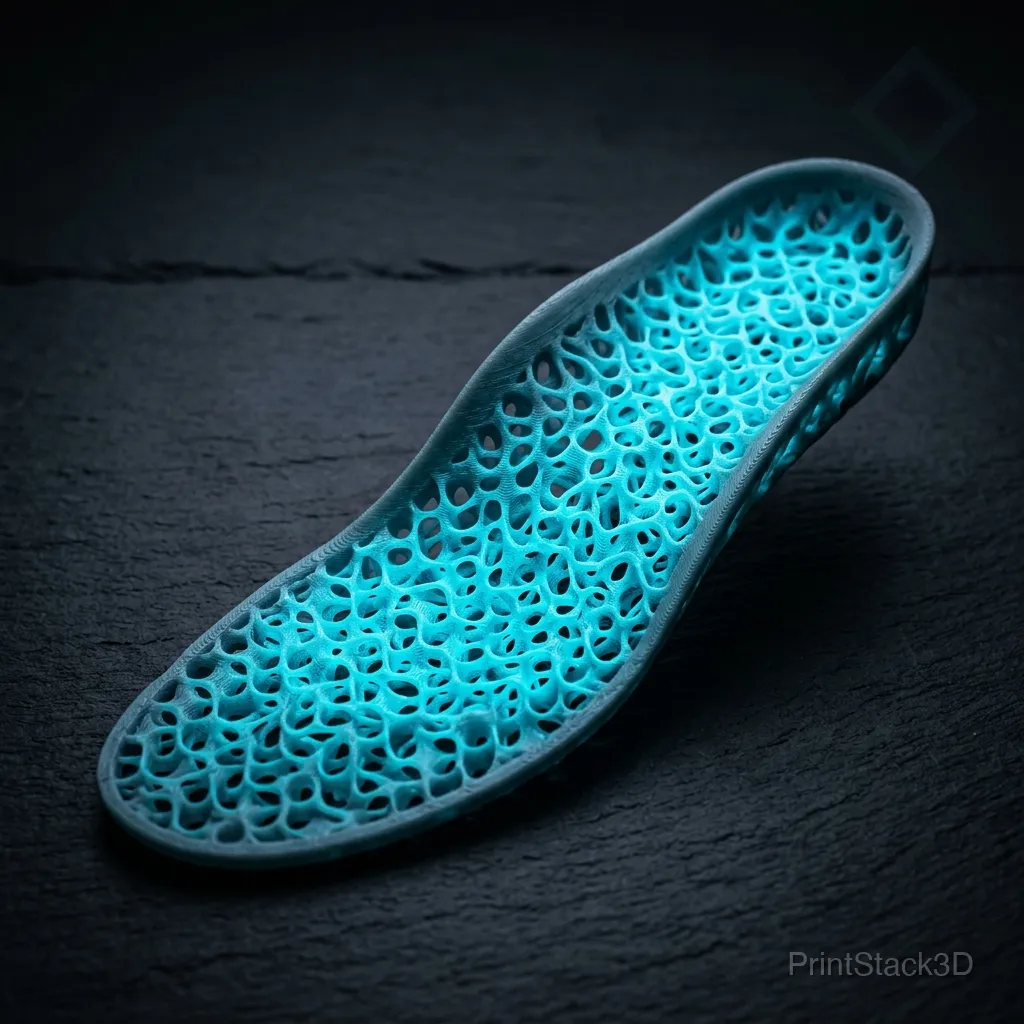
One of the most powerful applications of TPU is custom footwear. Traditional orthotics are expensive and time-consuming to manufacture. With 3D printing, you can create tailor-made insoles optimized for individual biomechanics:
- 3D Scanning: A 3D scan of the foot is taken to capture the exact shape and contours.
- Variable Density: In CAD, you can define different infill zones. For example, you can use a soft 10% Gyroid infill under the heel for impact absorption, transitioning to a firmer 30% infill under the arch to provide structural support.
- Breathability: By using open infill patterns without top and bottom solid layers, you can print highly breathable, ventilated insoles that stay comfortable all day.
Flexible filaments allow us to print objects that interact comfortably with the human body. By calibrating your settings and choosing the right shore hardness, you can start building custom wearables that are custom-tailored to you.
Frequently Asked Questions
Why is TPU ideal for 3D-printed wearables, gaskets, and custom insoles?
Thermoplastic Polyurethane (TPU Shore 95A) combines rubber-like elasticity and shock absorption with exceptional tear and abrasion resistance, while remaining impervious to sweat, oils, and water.
Can you tune the softness of a TPU print using infill settings?
Yes—by varying perimeter counts and gyroid infill density (e.g., 12% infill under the heel for cushioning and 35% under the arch for support), you can engineer variable-stiffness zones within one print.
Do TPU 3D prints delaminate when flexed repeatedly?
No. Properly dried and extruded TPU exhibits outstanding interlayer chemical bonding, surviving tens of thousands of flex cycles without cracking.