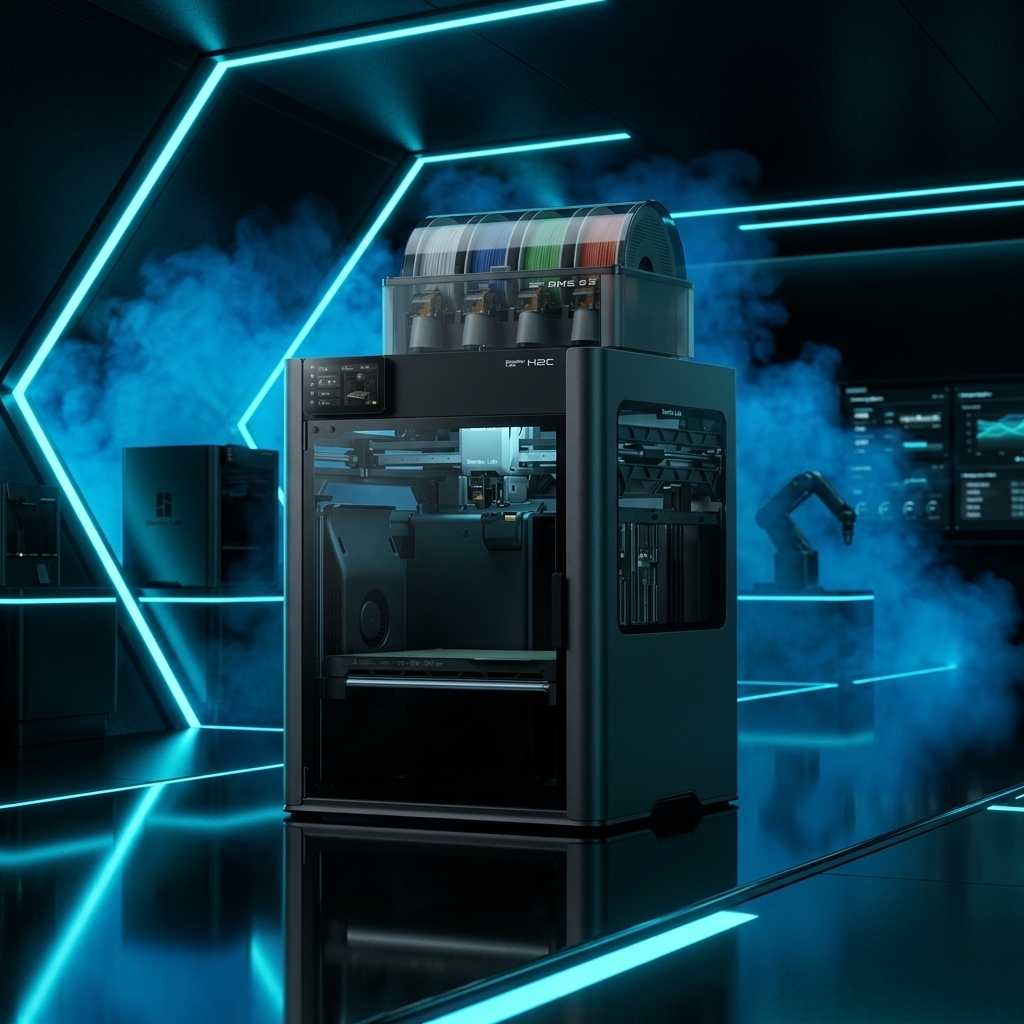
Bambu Lab H2 Series: Large-Format 3D Printing
PrintStack3D · 2026-04-13
Bambu Lab has once again disrupted the 3D printing industry. While their X1 and P1 series conquered the desktop market, the industrial and professional sectors have been waiting for a printer that combines Bambu's signature speed and ease of use with a massive build volume and industrial-grade reliability.
Enter the Bambu Lab H2 Series.
A Harmonious Industrial Design
The H2 series marks a shift towards a more mature, industrial aesthetic. The flagship H2C features a stunning matte charcoal finish with soft rounded edges, while the H2D and H2S sport premium silver side panels. A highlight of the design is the large, high-resolution touch interface seamlessly integrated into the top-left of the enclosure, providing real-time data from the printer's dozens of internal sensors.
Need this printed? Get an instant price for your model — upload it in the configurator with a free account.
Three Models, Specialized for Performance
The H2 series is a family designed to tackle different professional needs. All models feature a robust glass enclosure, active chamber heating (up to 80°C), and a radical new motion system capable of hitting 1000 mm/s with 30,000 mm/s² acceleration.
1. Bambu Lab H2C: The Flagship with "Vortek"
The H2C is the pinnacle of the series. It features the revolutionary Vortek Intelligent Swapping System and a specialized 330 x 320 x 325 mm³ build volume optimized for the swap mechanism.
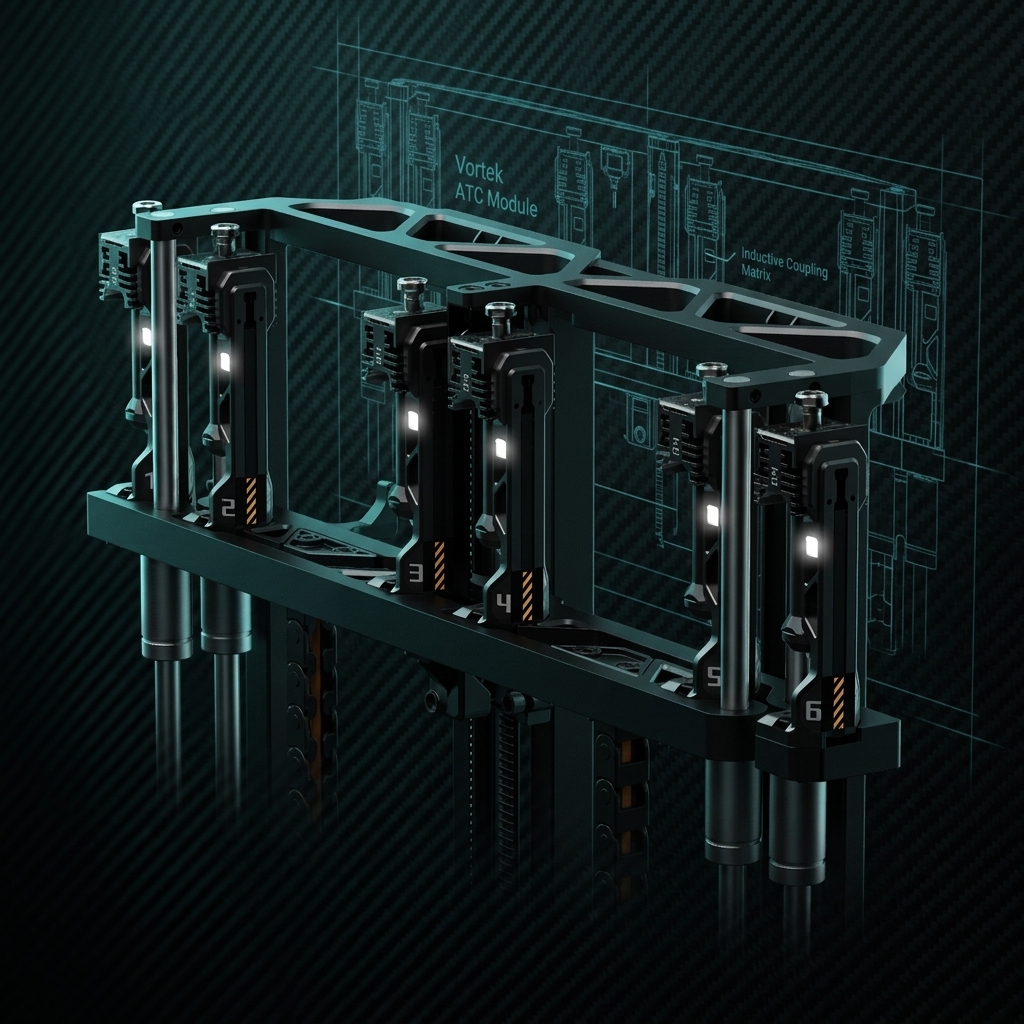
The Vortek system swaps out the entire hotend module in under 3 seconds using high-precision tool-changing logic. Combined with Inductive Nozzle Heating, it reaches print temperatures almost instantly and eliminates the "purge tower" waste common in multi-material printing.
2. Bambu Lab H2D: Massive Dual Extrusion
For those needing maximum volume with dual-material capabilities, the H2D offers a massive 350 x 320 x 325 mm³ space. It uses a refined dual-nozzle setup on a single head, providing independent control for complex geometries and soluble supports.
3. Bambu Lab H2S: High-Speed Precision
The H2S is the "Speed" variant, with a build volume of 340 x 320 x 340 mm. It utilizes high-torque closed-loop servo motors and 5μm Optical Motion Calibration to ensure that even at 1000 mm/s, the precision remains industrial-grade.
SEO & Specifications
For professional users looking to integrate the H2 series into their workflow, here are the key technical specifications:
| Feature | H2C (Flagship) | H2D (Dual) | H2S (Speed) |
|---|---|---|---|
| Build Volume | 330 x 320 x 325 mm | 350 x 320 x 325 mm | 340 x 320 x 340 mm |
| Cooling/Heating | Inductive + 80°C Chamber | Standard + 80°C Chamber | Standard + 80°C Chamber |
| Max Speed | 1000 mm/s | 800 mm/s | 1000 mm/s |
| Special Feature | Vortek System | Dual-Direct Drive | 5μm Optical Calibration |
Why it matters for PrintStack3D
At PrintStack3D, we are already preparing to integrate the H2 series into our farm. For our customers, this means:
- Zero-Waste Multi-Material: Thanks to the H2C's Vortek system, we can offer multi-color and multi-material prints with significantly less waste, reducing costs.
- Larger Functional Parts: The expanded volumes allow us to print larger single-piece functional components.
- Industrial Precision: With the new optical calibration, the dimensional accuracy of your parts will be better than ever.
Ready to see what the future of 3D printing looks like? Read our comprehensive engineering review of the next-generation flagship: the Bambu Lab H3C with 9-Tool Swaptek and AMS 3H.
Interested in professional large-format prints? Get an instant quote today.
Frequently Asked Questions
What advantages does the Bambu Lab H2 series bring to industrial 3D printing?
The Bambu Lab H2 series pairs an expanded build volume with active chamber heating, high-speed CoreXY motion, and multi-material support for warp-free engineering components.
What dimensional tolerances does PrintStack3D achieve on Bambu Lab hardware?
With active vibration compensation, eddy-current flow calibration, and enclosed chambers, we maintain standard tolerances of ±0.15 mm to ±0.20 mm (ISO 2768-m).
Which engineering filaments can be printed on these systems?
Beyond PLA and PETG, our fleet processes carbon-fiber composites (PETG-CF, PA-CF), UV-stable ASA, ABS, Polycarbonate (PC), and flexible TPU.