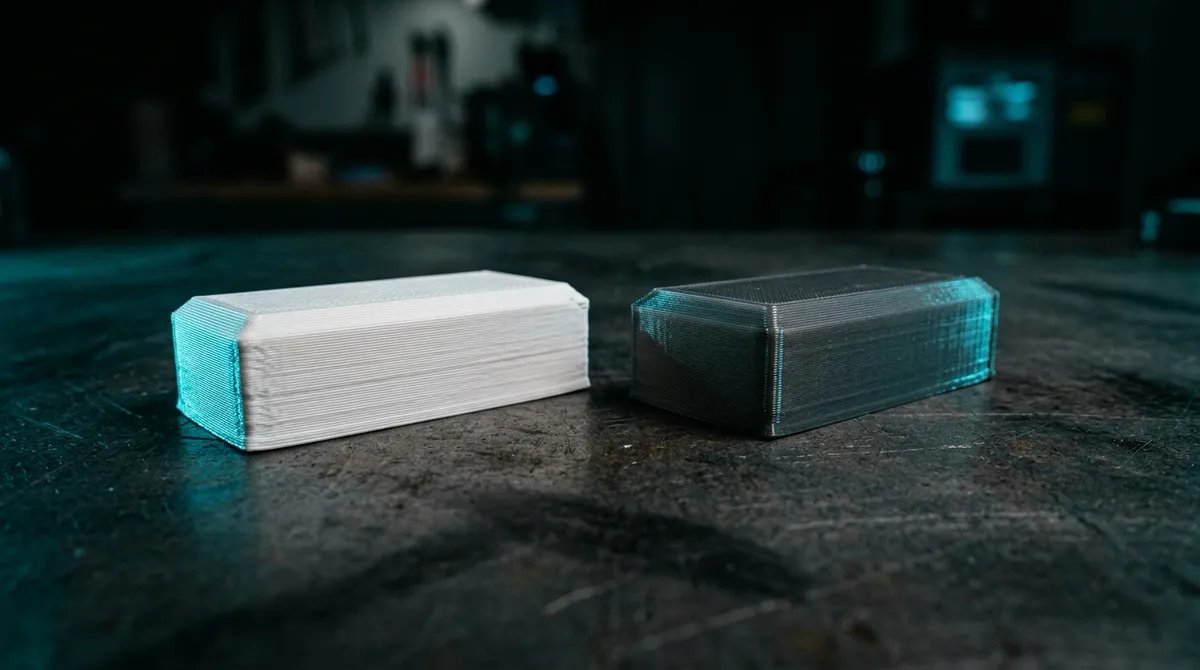
PLA vs PETG: which material suits your project?
PrintStack3D · 2026-04-10
PLA: lightweight, precise, easy
PLA (polylactic acid) is the world's most widely used FDM printing material. It's made from bio-based raw materials, biodegradable, and delivers excellent print results.
Strengths of PLA:
- High detail accuracy — suitable for fine geometries
- Beautiful surface finish with minimal post-processing
- Lowest price per gram
Limitations of PLA:
- Heat sensitive (deforms above ±60°C)
- Less impact-resistant than PETG
Best applications: decorative objects, cosplay props, gift items, prototypes.
Need this printed? Get an instant price for your model — upload it in the configurator with a free account.
PETG: stronger and water-resistant
PETG (polyethylene terephthalate glycol) combines the printability of PLA with the strength of ABS. It resists moisture and doesn't deform at higher temperatures.
Strengths of PETG:
- Higher toughness and impact resistance than PLA
- Water-resistant — suitable for outdoor use
- Temperature-resistant up to ±80°C
Limitations of PETG:
- Slightly higher price per gram
- Surface finish is slightly rougher than PLA
Best applications: functional parts, outdoor use, mechanical components, enclosures.
Summary
| Property | PLA | PETG |
|---|---|---|
| Price | Lower | Slightly higher |
| Detail accuracy | High | Medium |
| Heat resistance | Limited | Good |
| Impact resistance | Medium | High |
| Water-resistant | No | Yes |
Still not sure? Upload your STL or 3MF when ordering and mention your application in the notes. We'll be happy to advise you.
Frequently Asked Questions
What is the main difference between PLA and PETG in 3D printing?
PLA is stiffer, captures finer surface details, and is ideal for visual prototypes and indoor parts up to 55 °C. PETG is tougher, more impact-resistant, hydrophobic, and heat-resistant up to 75–80 °C, making it better suited for functional and outdoor parts.
Can PLA be used outdoors?
We do not recommend PLA for permanent outdoor use in direct sunlight because it softens above 55 °C. For outdoor enclosures and brackets, choose PETG or UV-stabilized ASA.
Which material is more affordable to 3D print?
Standard PLA has the lowest cost per gram and fastest print speeds, though PETG costs only a few cents more per gram in our online quoting tool.