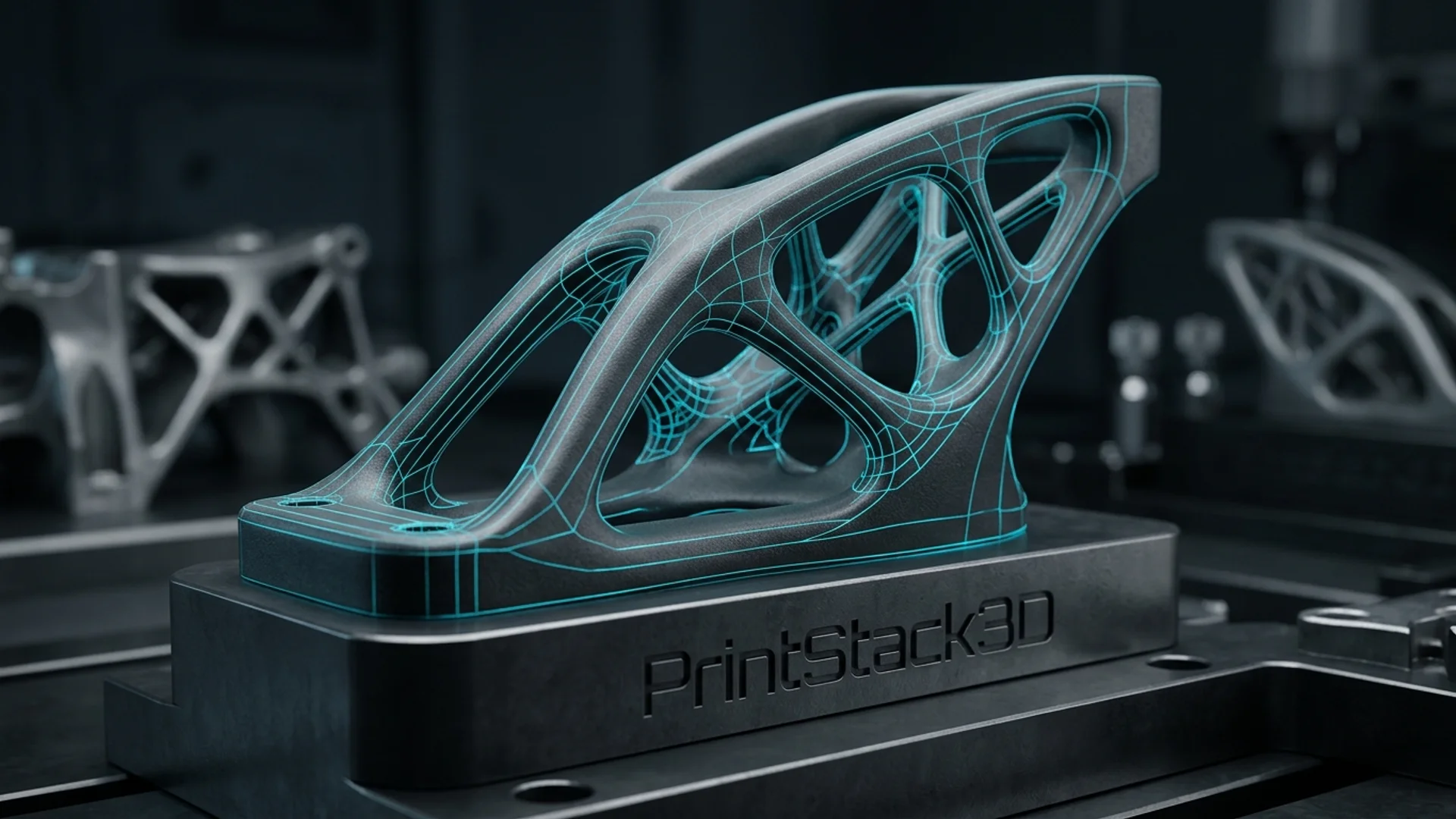
From Generative AI CAD to Physical Parts: Optimizing Lattices & Topology for 3D Printing
PrintStack3D · 2026-08-18
The AI Generative Revolution in CAD Design
In 2026, artificial intelligence has reshaped computer-aided design (CAD). Generative AI algorithms (integrated into platforms like nTop, Autodesk Fusion AI, and text-to-3D mesh generators) allow engineers to input mechanical load constraints, mounting points, and weight targets, automatically outputting hyper-lightweight organic geometries that mimic biological bone structures.
By removing material from zero-stress regions and synthesizing complex internal cellular lattices, generative design achieves weight reductions of 30% to 60% while maintaining or improving component stiffness.
However, moving an AI-generated 3D CAD model from a digital render to a physically printed end-use part poses severe manufacturing hurdles. AI algorithms design for mathematical purity—not layer-by-layer slicer physics.
Without proper Design for Additive Manufacturing (DFAM) optimization, raw generative meshes suffer from unprintable overhangs, trapped support structures, thin walls, and mesh self-intersections.
Understanding Lattice Geometries: Gyroid vs Diamond vs Voronoi
Replacing solid interior volume with mathematical lattice structures is one of the most effective ways to lightweight load-bearing parts. The choice of lattice cell geometry impacts mechanical response:
1. Triply Periodic Minimal Surfaces (TPMS - Gyroid & Schwarz)
- Characteristics: Continuous curved surfaces with no sharp internal corners or stress concentration nodes.
- Why It's Ideal for FDM/SLA: Gyroid lattices are inherently self-supporting up to 45-50° angles, eliminating internal support requirements. They offer isotropic strength, distributing stress equally across X, Y, and Z axes.
2. Strut-Based Cubic & Octet Lattices
- Characteristics: Interconnected network of micro-beams and nodal points.
- Applications: High energy absorption impact bumpers and aerospace stiffness-critical frames.
- DFAM Caution: Nodes can create local stress risers if fillets are not applied at beam intersections.
3. Voronoi Organic Lattices
- Characteristics: Bio-inspired cellular structures resembling coral or trabecular bone.
- Applications: Orthotics, custom prosthetics, and lightweight drone frames.
5 Essential Rules to Prepare AI CAD Models for 3D Printing
To transform AI generative CAD concepts into high-yield 3D printed components, follow these core optimization steps:
1. Enforce the Self-Supporting Overhang Rule (>45°)
Generative algorithms often create organic arches with shallow horizontal ceilings. Adjust generative orientation vectors or apply overhang angle constraints (>45° relative to the build plate) to ensure all overhangs print cleanly without internal support structures.
2. Repair Mesh Topology & Solidify B-Reps
AI text-to-3D generators often export raw non-manifold STL/OBJ polygon meshes containing open edges, inverted normals, and intersecting faces. Convert non-manifold meshes into watertight STEP/B-Rep solids before slicing to ensure correct wall thickness calculation.
3. Apply Minimum Wall Thickness Constraints
While AI solvers optimize stress lines down to fractional millimeters, FDM and SLA processes require minimum feature sizes:
- FDM (0.4mm nozzle): Minimum wall thickness of 1.2 mm (3 perimeter loops) to prevent delamination.
- Resin SLA/DLP: Minimum wall thickness of 0.8 mm for unreinforced features.
4. Provide Resin Drainage & Powder Escape Vents
If manufacturing hollow lattice parts using SLA resin or SLS powder beds, incorporate at least two Ø4-6 mm escape vents near the base to allow uncured liquid resin or un-sintered powder to drain out completely.
5. Reinforce High-Stress Load Points with Solid Zones
Never allow lattice structures to terminate directly under bolt heads or bearing seats. Define solid boundary zones (5-10 mm solid shell thickness) around mounting holes, heat-set insert locations, and pin joints to sustain mechanical clamping forces.
Case Study: Lightweighting a Drone Motor Mount
By combining Autodesk generative design with PrintStack3D carbon-fiber PETG-CF printing, a commercial drone development team optimized a motor arm assembly:
- Original Machined Aluminum Part: 185 grams
- AI Generative Topology + Gyroid Infill: 92 grams (50.2% weight saving)
- Performance: Passed 10G vibration stress testing with zero layer separation.
Bring Your Generative AI Models to Life with PrintStack3D
At PrintStack3D, our advanced slicing pipelines and high-performance carbon-reinforced materials ensure your AI-generated CAD designs transition seamlessly into strong physical parts.
For material selection and production advice, see our filament guide and engineering services.
Frequently Asked Questions
Can AI-generated CAD models be 3D printed directly?
Usually not without preparation. AI generators often export non-manifold meshes with thin walls and unprintable overhangs. Repair the mesh, enforce wall-thickness constraints, and respect the >45° overhang rule before printing.
What is the strongest lattice structure for 3D printing?
Gyroid (a triply periodic minimal surface) offers the best balance: it is self-supporting up to 45–50° overhangs and provides isotropic strength in all directions.
Does PrintStack3D accept AI-generated or generative CAD files?
Yes — upload your STL or 3MF files and we handle print preparation for your AI-designed parts, with an instant quote online.