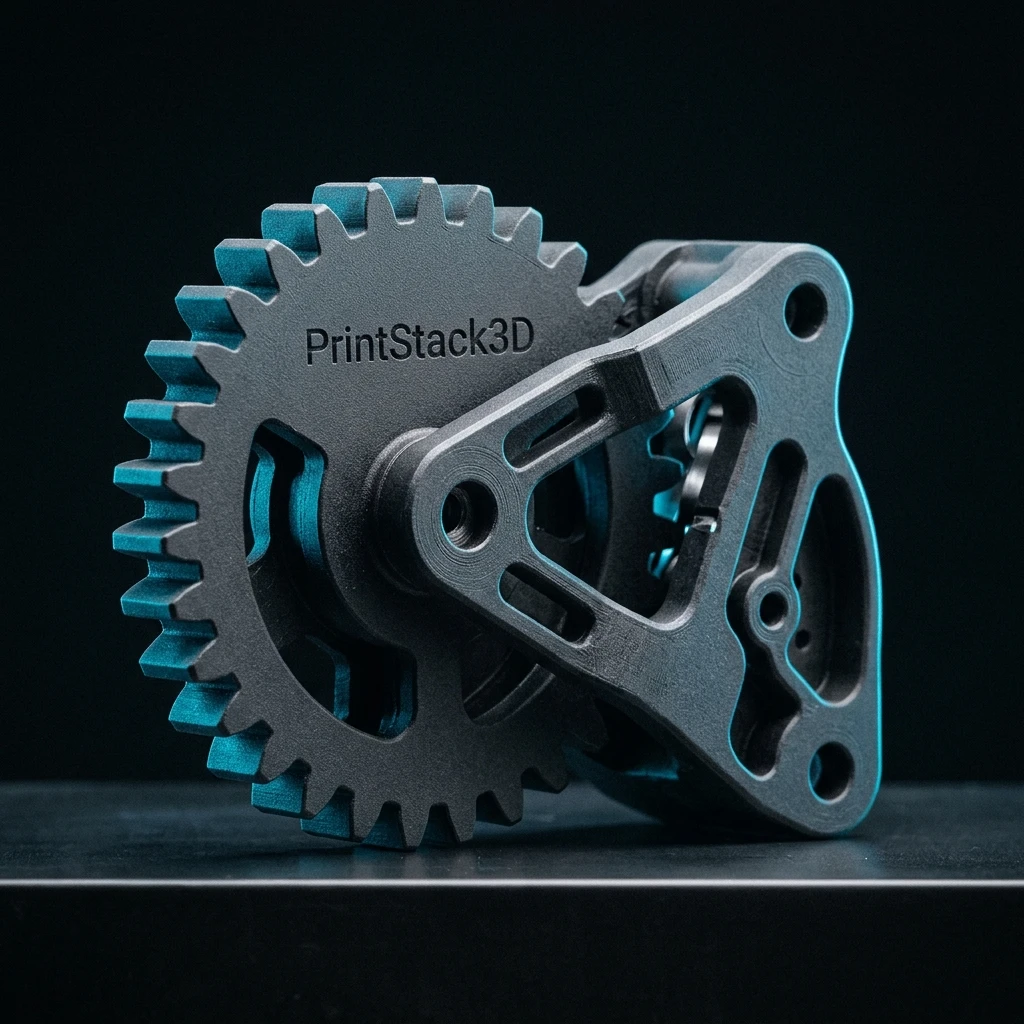
EU Right to Repair: 3D-Printed Spare Parts
PrintStack3D · 2026-07-20
A Legal Revolution in Repairability
| Part category | Typical failure | 3D-print fix |
|---|---|---|
| Appliance knobs, gears | Wear, stripping | PETG / PA-CF replacements |
| Automotive clips, brackets | Brittle fracture | ASA / ABS parts |
| Machine guards, covers | Cracking | PETG with heat-set inserts |
| Vintage spare parts | No longer manufactured | Reverse-engineered one-offs |
As of July 2026, the EU Right to Repair Directive (Directive (EU) 2024/1799) is officially in force across all EU member states, including Belgium, the Netherlands, Luxembourg, and Germany. This directive changes the balance of power between product manufacturers, independent repair shops, and consumers.
A core pillar of this legislation is the protection and validation of 3D-printed spare parts. Under the new rules, manufacturers are legally barred from using software locks, hardware restrictions, or patent claims to prevent independent repairers or consumers from using 3D-printed parts—provided the parts meet basic safety and regulatory standards.
For the 3D printing industry, this is a major transition from hobbyist fabrication to legally protected, functional manufacturing.
Need this printed? Get an instant price for your model — upload it in the configurator with a free account.
Bypassing Obsolete Inventory
Traditionally, the primary challenge of maintaining older machinery, consumer electronics, or domestic appliances was the availability of parts. Manufacturers routinely discontinued replacement components after a few years, forcing premature replacement of otherwise functional products.
The EU Right to Repair directive addresses this directly. Manufacturers are now required to make repair information and spare parts accessible for a minimum of 5 to 10 years depending on the product category. To avoid the massive overhead of keeping physical warehouses stocked with slow-moving spare parts, many companies are shifting to digital warehousing:
- Digital CAD Warehouses: Storing spare parts as digital files instead of physical plastic pieces.
- On-Demand Production: Manufacturing parts only when needed, minimizing storage costs and material waste.
- Localized Manufacturing: Printing the required part close to the customer, dramatically lowering shipping times and carbon footprint.
Industrial-Grade Performance on Demand
While the law now protects the right to print replacement parts, a standard desktop 3D printer often lacks the dimensional precision and material strength required for functional components. A gear, bracket, or mechanical latch must withstand significant mechanical load.
At PrintStack3D, we bridge this gap by offering professional additive manufacturing services:
- High-Performance Materials: We print functional parts in carbon fiber composites (PETG-CF), high-strength polymers (PETG, ASA), and flexible wear-resistant materials (TPU).
- Industrial Calibration: Using state-of-the-art Bambu Lab machinery, we maintain dimensional accuracy down to ±0.1 mm—essential for gears and interlocking mechanical assemblies.
- Guaranteed Results: Failed home prints lead to wasted filament and lost time. PrintStack3D guarantees perfect execution, taking the risk out of functional repairs.
Whether you are an independent repair professional servicing appliances in Germany or a consumer looking to fix a custom bracket in the Netherlands, localized 3D printing is no longer just a workaround. It is the new, legally protected standard.
Frequently Asked Questions
What does the EU Right to Repair directive require from hardware manufacturers?
The European Right to Repair framework obligates manufacturers to keep replacement spare parts available at reasonable prices and lead times for 7 to 10 years after a product leaves the market.
How does on-demand 3D printing help companies comply with Right to Repair?
Instead of warehousing slow-moving plastic spare parts for a decade, OEMs maintain a digital CAD library and manufacture replacement parts on demand via PrintStack3D with zero inventory holding costs.
Are 3D-printed replacement parts durable enough for commercial appliances?
Yes—using engineering polymers like PETG-CF, ASA, and Polycarbonate with ±0.15 mm dimensional accuracy, our parts match or exceed original molded component durability.