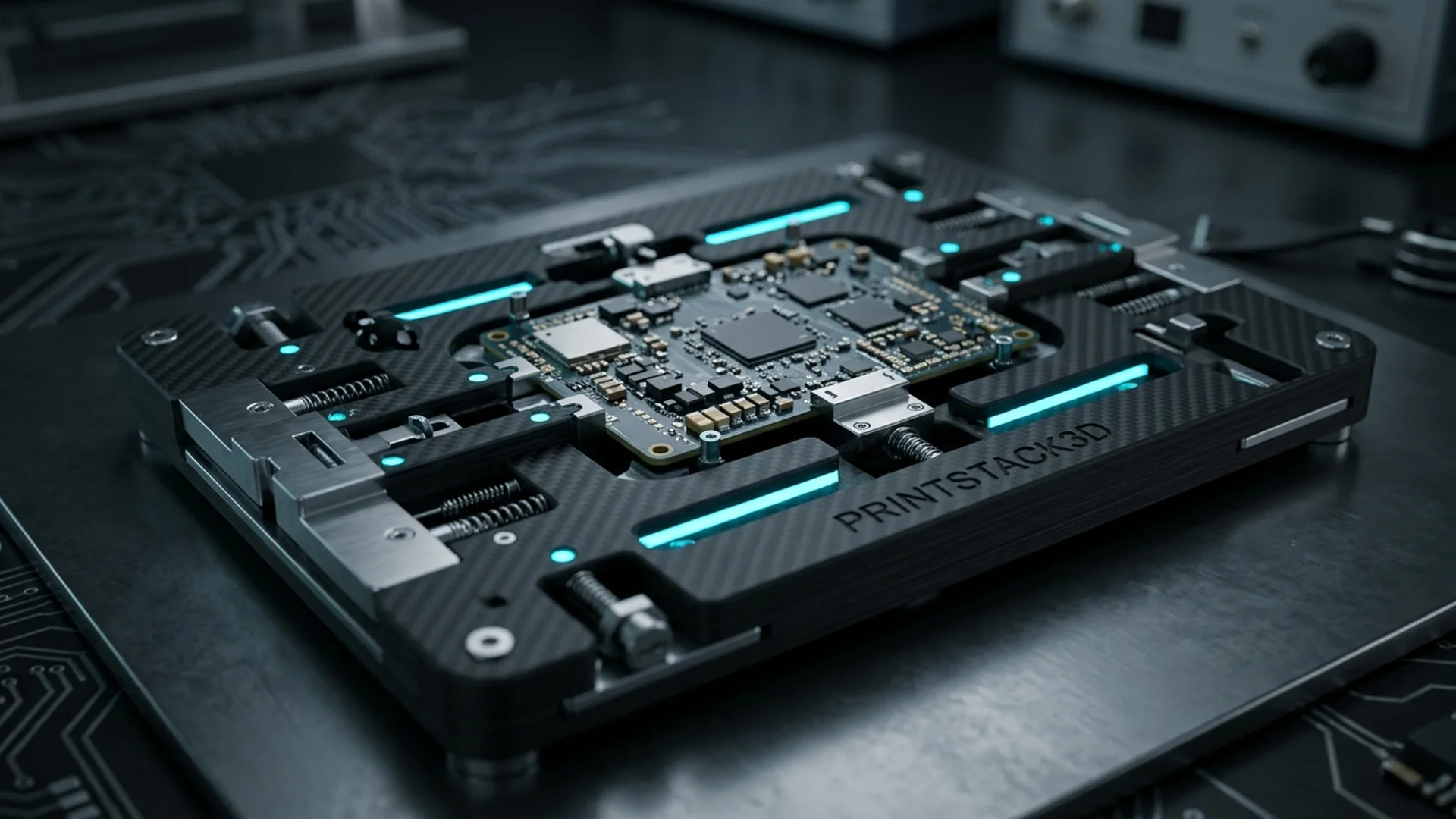
ESD-Safe 3D Printing: Manufacturing Static-Dissipative Fixtures & Electronics Enclosures
PrintStack3D · 2026-08-18
The Hidden Risk of Electrostatic Discharge (ESD) in Electronics Manufacturing
In modern electronics assembly and hardware manufacturing, electrostatic discharge (ESD) is an invisible yield killer. Microscopic electrical charges—often reaching thousands of volts from simple handling or air friction—can discharge through sensitive microcontrollers, surface-mount ICs, and high-frequency RF modules. This results in immediate component failure or, worse, latent defects that slip past quality control and fail after customer delivery.
Traditionally, electronics assembly lines relied on custom CNC-machined ESD aluminum fixtures or static-safe injection-molded trays. However, prototype iterations and low-to-medium volume manufacturing demand much faster turnarounds.
Standard 3D printing plastics like PLA, standard PETG, or ABS are electrical insulators. As non-conductive materials, they store static electrical charges up to 10,000V on their surface. Bringing an insulating plastic mounting jig near a populated Printed Circuit Board (PCB) poses an extreme risk of electrostatic destruction.
Modern additive manufacturing now offers dedicated static-dissipative ESD-safe filaments designed specifically for electronics production tooling, cleanroom fixtures, and sensitive component housings.
Understanding Surface Resistivity in ESD-Safe Additive Materials
When specifying materials for electronics manufacturing equipment, materials are categorized by their surface resistivity (Ω/sq):
- Insulating Materials (>10¹¹ Ω/sq): Standard PLA, PETG, TPU, and ABS. They hold static charges indefinitely and discharge rapidly upon contact with conductors.
- Static-Dissipative Materials (10⁶ Ω/sq to 10⁹ Ω/sq): The gold standard for ESD safety. Charges flow slowly and safely to ground without sparking or sudden current spikes.
- Conductive Materials (<10⁵ Ω/sq): Carbon-black loaded polymers that allow immediate current flow. They are rarely used for direct PCB contact because short circuits could occur if powered boards touch the fixture.
Modern ESD-safe filaments incorporate embedded carbon nanotube (CNT) networks or non-sloughing conductive additives into matrix polymers like PETG, ABS, and TPU. This maintains a precise surface resistivity strictly within the safe 10⁶ to 10⁹ Ω/sq range.
ESD-Safe Material Selection: PETG-ESD vs ABS-ESD vs TPU-ESD
Choosing the right base polymer depends on mechanical requirements and working environments:
1. PETG-ESD (Best All-Rounder)
- Properties: High impact strength, excellent chemical resistance to isopropyl alcohol (IPA) circuit board cleaners, and minimal warping.
- Applications: PCB assembly holding trays, wave soldering carrier frames, testing jigs, and benchtop organizers.
- Why Engineers Choose It: Combines high dimensional accuracy with resistance to benchtop solvents.
2. ABS-ESD (High Temperature & Rigidity)
- Properties: High heat deflection temperature (HDT up to 85-95°C), superior rigidity, and machinability.
- Applications: Automated testing equipment (ATE) fixtures, burn-in test sockets, thermal chamber trays, and automated pick-and-place end-effectors.
3. TPU-ESD (Flexible & Non-Marring)
- Properties: Flexible (Shore 95A), shock-absorbent, and static-dissipative.
- Applications: Soft-touch component grippers, protective bumper caps for sensitive display glass, custom gasket seals, and anti-vibration feet for desktop instruments.
Engineering Applications for 3D Printed ESD Fixtures
By replacing subtractive metal tooling with professional 3D printed ESD-safe fixtures, electronics engineering teams achieve major speed and cost benefits:
- Custom PCB Test & Programming Jigs: Fast 3D printing allows custom alignment pins, pogo-pin bed-of-nails clamps, and toggle-latch lids to be manufactured within 24 hours.
- SMT Component Handling Trays: Tailored pocket geometry prevents component movement during transport across assembly stations without accumulating static charges.
- Cleanroom & Assembly Tool Handles: Custom ergonomic handles for torque drivers, pliers, and suction tools printed in ESD plastic eliminate static buildup from operator hands.
- Prototyping Commercial Enclosures: Before committing to high-cost ESD injection molding tooling, 3D printed ESD enclosures allow realistic testing of electromagnetic compatibility and ESD immunity.
Key DFAM Design Rules for ESD-Safe Parts
To ensure maximum ESD performance and structural integrity:
- Avoid Sharp Interior Corners: Radiused interior corners (R ≥ 1.5 mm) reduce localized stress and maintain consistent conductive carbon nanotube dispersion across the part geometry.
- Grounding Integration: Design recessed screw mounts for brass heat-set inserts or grounding cables to provide a clean path to ESD benchtop ground mats.
- Layer Orientation for Resistivity: Surface resistivity can vary slightly between print layer planes and Z-axis walls. Align critical PCB locator surfaces parallel to the print bed for optimal conductivity consistency.
- No-Sloughing Requirements: Ensure the ESD filament is carbon-nanotube (CNT) based rather than cheap carbon powder. CNT-based filaments prevent loose carbon dust contamination in cleanrooms.
Accelerate Your Electronics Production with PrintStack3D
PrintStack3D manufactures industrial-grade ESD-safe fixtures, PCB jigs, and custom electronics housings with rapid lead times and certified surface resistivity.
See our engineering services for custom production tooling, or read more engineering guides on our blog.
Frequently Asked Questions
What makes a 3D printed part ESD-safe?
ESD-safe parts use carbon-nanotube-filled filaments with a surface resistivity of 10⁶–10⁹ Ω/sq, so static charges dissipate slowly and safely to ground instead of discharging into sensitive components.
Which ESD material should I choose?
PETG-ESD is the best all-rounder (solvent-resistant, accurate). Choose ABS-ESD for higher temperature and rigidity, and TPU-ESD for flexible, non-marring parts like grippers and bumpers.
Can PrintStack3D produce ESD-safe jigs and fixtures?
Yes — we print industrial ESD-safe fixtures, PCB jigs, and enclosures in ESD filaments. Upload your CAD files for an instant quote.