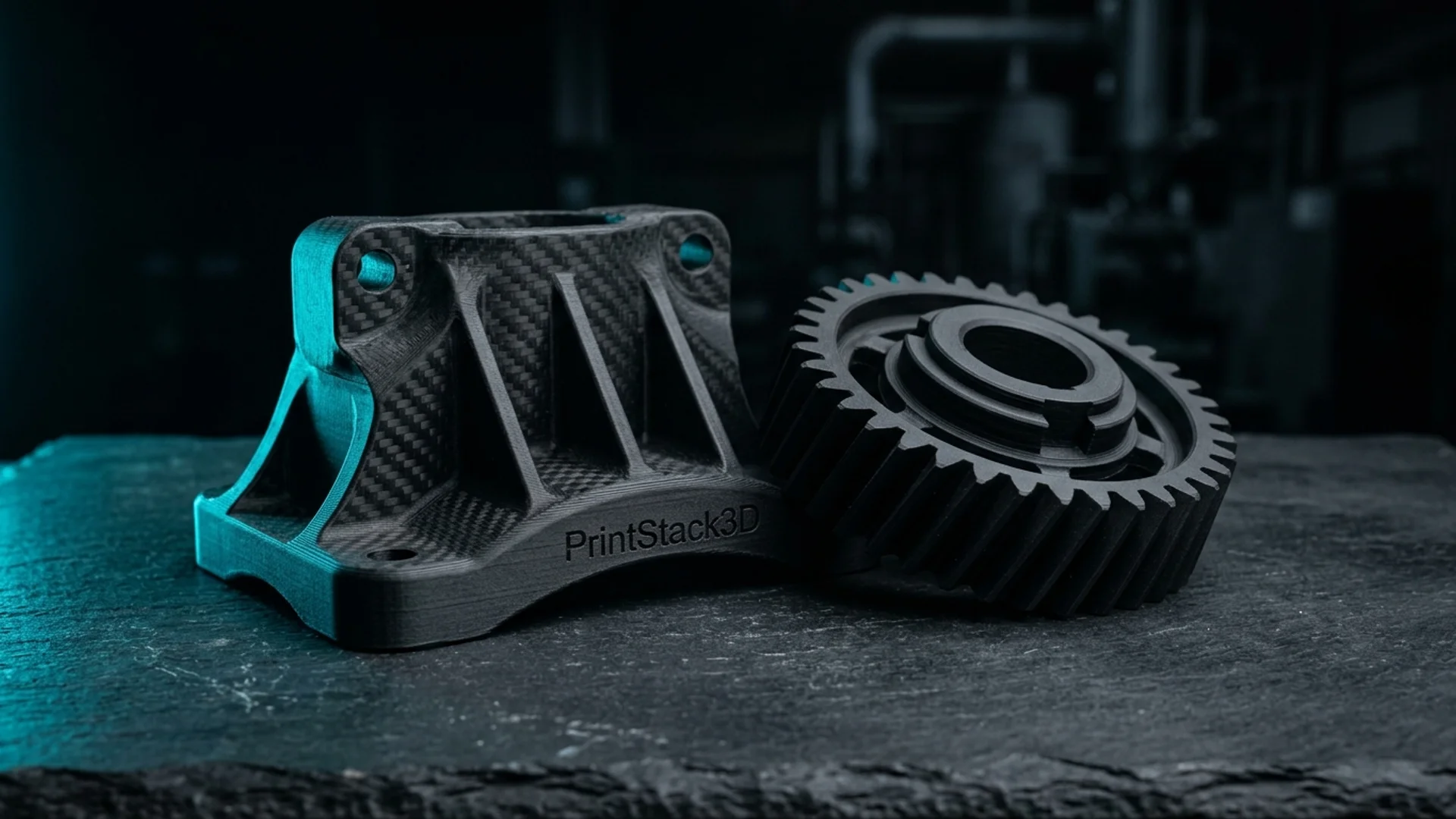
Digital Inventory: 3D-Printed Spare Parts on Demand
PrintStack3D · 2026-10-01
The High Cost of Physical Spare Parts in Industrial Manufacturing
In modern machine building, automation, and industrial maintenance (MRO), spare parts management presents a persistent dilemma. To avoid catastrophic machine downtime, plant managers hold thousands of parts in storage: from cable carriers and sensor brackets to specialized machine covers and gear transmissions.
However, physical warehousing carries significant structural penalties:
- High Capital Holding Costs: Storing physical inventory typically costs between 20% and 25% of purchase value every year in warehouse rent, climate control, logistics, and insurance.
- Obsolescence and Waste: Approximately 15% to 30% of stored industrial replacement parts are eventually scrapped without ever being installed, as machinery is modernized or decommissioned.
- Minimum Order Quantities (MOQs): Traditional injection molding or casting suppliers frequently refuse single-piece orders, forcing companies to buy hundreds of units when only one is needed.
- Supply Chain Disruption: Overseas supplier lead times for legacy or discontinued machinery components routinely extend to 8 to 16 weeks.
In 2026, leading European manufacturers are executing a strategic shift: digitizing spare parts inventories through on-demand additive manufacturing.
Need this printed? Get an instant price for your model — upload it in the configurator with a free account.
How Digital Warehousing Works in Practice
A digital warehouse replaces shelving filled with cardboard boxes with a secure, verified repository of 3D CAD models (STEP) and production presets (3MF slices with fixed perimeter counts, infill densities, and material specifications).
Traditional Supply Chain:
Design → Injection Mold Tooling (€5,000+) → Batch (500 units) → Logistics → Years of Storage → Installation

Digital Inventory:
Part File (CAD/3MF) in Cloud → On-Demand Order (1 to 10 units) → 3D Printed within 24h → Direct Assembly
When a maintenance technician identifies a worn component:
- The part number is retrieved from the digital repository.
- The model file is uploaded instantly to the PrintStack3D production pipeline.
- Automated manufacturing begins within hours on our industrial production farm.
- The replacement part arrives on site ready for installation within 24 to 48 hours.
Which Parts Benefit Most from Digital Inventory?
Not all components should be digitized. Standardized fasteners (DIN bolts) and commodity ball bearings remain cheaper via mass production. The greatest return on investment from a digital inventory occurs with:
1. Custom Machine Components and Brackets
Sensor mounts, optical mirror fixtures, pneumatic manifolds, and alignment brackets designed specifically for proprietary machines.
2. Wear Parts and Guides
Cable chains, linear sliding blocks, product deflectors, and conveyor belt pushers that wear periodically under continuous operation.
3. Housings and Enclosures
Junction boxes, HMI display bezels, cable glands, and protective shields that must be replaced quickly following impact damage.
4. Legacy Parts for Discontinued Machinery
When the original equipment manufacturer (OEM) is no longer in business or has discontinued spare support, defective parts can be measured or 3D scanned once and archived digitally for infinite future reproduction.
Technical Materials for Mechanical Load Bearing
A digital replacement part must match or exceed the structural integrity of the original part. PrintStack3D manufactures industrial spare parts in high-grade engineering polymers:
| Material | Key Mechanical Characteristic | Typical Industrial Use Case |
|---|---|---|
| PETG-CF | High stiffness, dimensional stability, chemical resistance | Mounting brackets, sensor mounts, electrical cabinet adapters |
| PA-CF (Carbon Nylon) | Exceptional tensile strength, impact absorption | Gears, levers, high-load mechanical couplings |
| Polycarbonate (PC) | High thermal resistance (HDT > 110°C), flame retardance | Motor covers, high-heat machine compartments |
| TPU (Shore 95A) | High abrasion resistance, vibration dampening | Gaskets, protective bumpers, soft gripper profiles |
| ASA | UV and weather proof, colorfast | Outdoor equipment, agricultural machinery, vehicle fittings |
Roadmap: Transitioning from Physical Shelves to a Digital Library
Migrating to a digital spare parts inventory can be executed methodically in four actionable steps:
- Inventory Pareto Analysis: Identify the 20% of parts that account for 80% of storage volume or capital tie-up and suffer from low turnover rates.
- CAD Standardization: Ensure clean, native STEP or 3MF files exist with documented tolerances and material designations.
- Physical Validation: Produce an initial pilot part to verify tolerances, mechanical fit, and operational performance on the actual machine.
- On-Demand Procurement Protocol: Integrate the validated models into your procurement process, allowing maintenance teams to trigger immediate on-demand manufacturing whenever downtime occurs.
Start On-Demand Production with PrintStack3D
Eliminating physical storage racks in favor of a digital inventory frees capital and secures operational continuity. PrintStack3D acts as your local, instant manufacturing partner in the Netherlands and Europe.
Explore our engineering services for custom manufacturing and digital inventory consulting, or browse our technical 3D printing guides on the blog. For parts you need on a recurring basis or as a production run, go straight to our parts on demand production.
Frequently Asked Questions
What is digital inventory in 3D printing?
Digital inventory replaces physically stored spare parts with certified cloud CAD and 3MF files. Parts are manufactured exclusively when they are actually needed (just-in-time).
How much cost can a digital warehouse save compared to a physical warehouse?
Maintaining physical inventory typically incurs holding costs of 20% to 25% of total procurement value annually due to space, handling, and obsolescence. Digital inventory reduces holding costs to near zero and eliminates minimum order quantities (MOQs).
Are 3D-printed spare parts strong enough for industrial machinery?
Yes. Using industrial technical filaments such as PETG-CF, PA-CF (carbon fiber reinforced nylon), polycarbonate, and ASA, 3D printed components provide the tensile strength, stiffness, and chemical resistance required in heavy operating environments.
How fast can PrintStack3D deliver a spare part from a digital CAD file?
Our automated printer fleet begins production immediately once an order is placed. Parts are typically manufactured and dispatched within 24 to 48 hours.