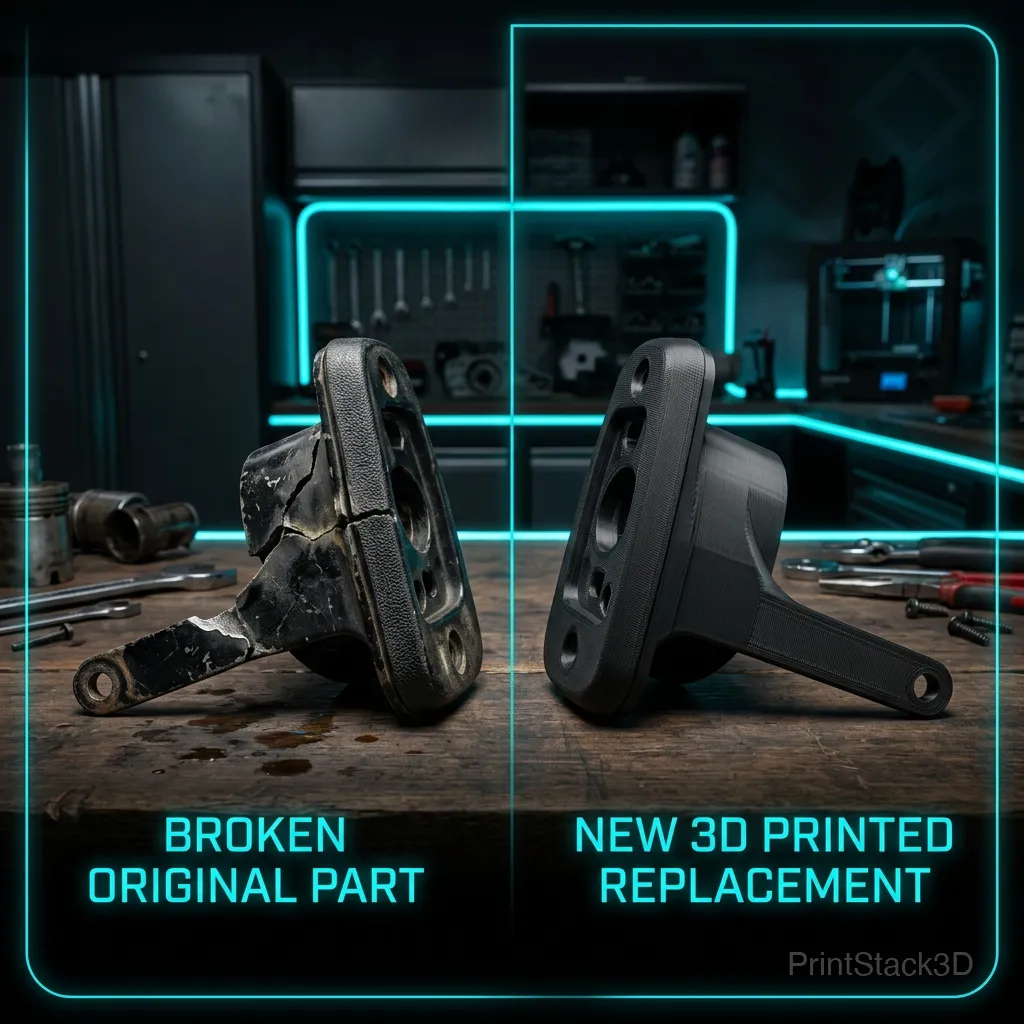
Recreating Obsolete Automotive Parts in 3D
PrintStack3D · 2026-06-13
The Obsolete Parts Dilemma
For classic car enthusiasts and restorers, the biggest challenge isn't mechanical repair—it's sourcing parts. When a vehicle is fifty years old, finding original equipment manufacturer (OEM) replacement parts is often a game of luck. If a plastic dashboard knob, a cooling vent, or a window crank gear breaks, the part may simply no longer exist.
Traditionally, you would have to source a donor car or pay thousands of dollars for a machinist to custom-make a single component. Today, 3D printing and digital manufacturing have changed the game, allowing restorers to recreate obsolete parts with OEM-level precision from their own workshop.
Need this printed? Get an instant price for your model — upload it in the configurator with a free account.
Step-by-Step Reverse Engineering
Recreating a classic automotive part requires a methodical workflow to ensure mechanical and visual accuracy:
1. Capturing the Geometry
If you have the broken original part, you can capture its shape using a 3D scanner. If the part is completely missing but has a symmetrical equivalent on the opposite side of the vehicle (such as a left side mirror bracket), you can scan that instead and mirror the digital model. For simpler parts, manual measurements using digital calipers and thread gauges are highly effective.
2. Modeling in CAD
Using CAD software like Fusion 360, you recreate the part digitally. This is where you can optimize the design. Classic car plastics from the 1970s and 1980s were notorious for cracking due to poor engineering or cheap materials. In CAD, you can increase wall thickness, add reinforcing ribs, or optimize geometry to make the new part significantly more durable than the original.
Material Selection: Choosing the Right Filament
Automotive environments are incredibly harsh. Temperatures inside a car parked in the sun can easily exceed 70 °C, while under-the-hood temperatures can exceed 120 °C. Standard PLA will melt, and PETG will warp. You must choose engineering-grade filaments:
| Filament | Best Used For | Key Properties |
|---|---|---|
| ASA | Exterior trim, badges, mirrors, dashboard parts | Outstanding UV resistance, weather resistance, and heat deflection temperature up to 95 °C. |
| Nylon-CF | Under-the-hood brackets, gear shifter bushings, gears | Exceptional thermal resistance (150 °C+), high impact strength, and excellent chemical resistance against oil and fuel. |
| TPU | Gaskets, wiring grommets, bump stops | Flexible, high abrasion resistance, and chemical durability. |
Post-Processing for a Factory Look
A raw 3D print with visible layer lines can look out of place on a meticulously restored classic car. Fortunately, engineering materials like ASA are highly responsive to post-processing:
- Sanding and Painting: Start with 180-grit sandpaper and work up to 600-grit. Apply a high-build plastic primer, sand it flat, and paint it with a UV-stable automotive paint matching the factory color.
- Acetone Vapor Smoothing: ASA dissolves in acetone. Placing the printed part in a controlled chamber with warm acetone vapor briefly melts the outer surface. This flows into the layer gaps, creating a completely smooth, glossy finish that mimics original injection-molded plastics.
By utilizing modern reverse-engineering tools and advanced engineering filaments, classic car owners are no longer at the mercy of rare-parts hoards. You can print the future of automotive history, one layer at a time.
Frequently Asked Questions
Which 3D printing filament withstood classic car cabin heat and under-hood environments?
For dashboard trim, vents, and exterior badges exposed to sun heat up to 95 °C, UV-stabilized ASA is ideal. For under-hood brackets and bushings exposed to oil, fuel, and 120 °C+ heat, choose PA-CF (Carbon Fiber Nylon) or PETG-CF.
Can discontinued No-Longer-Available (NLA) car parts be reproduced from a broken original?
Yes—broken vintage trim pieces and clips can be measured or 3D scanned, reconstructed in CAD, and printed on demand without tooling costs.
Can 3D-printed automotive parts be sanded and painted to match OEM trim?
Yes, ASA and PETG-CF sand cleanly and accept standard automotive plastic primers, texture coatings, and OEM topcoats.