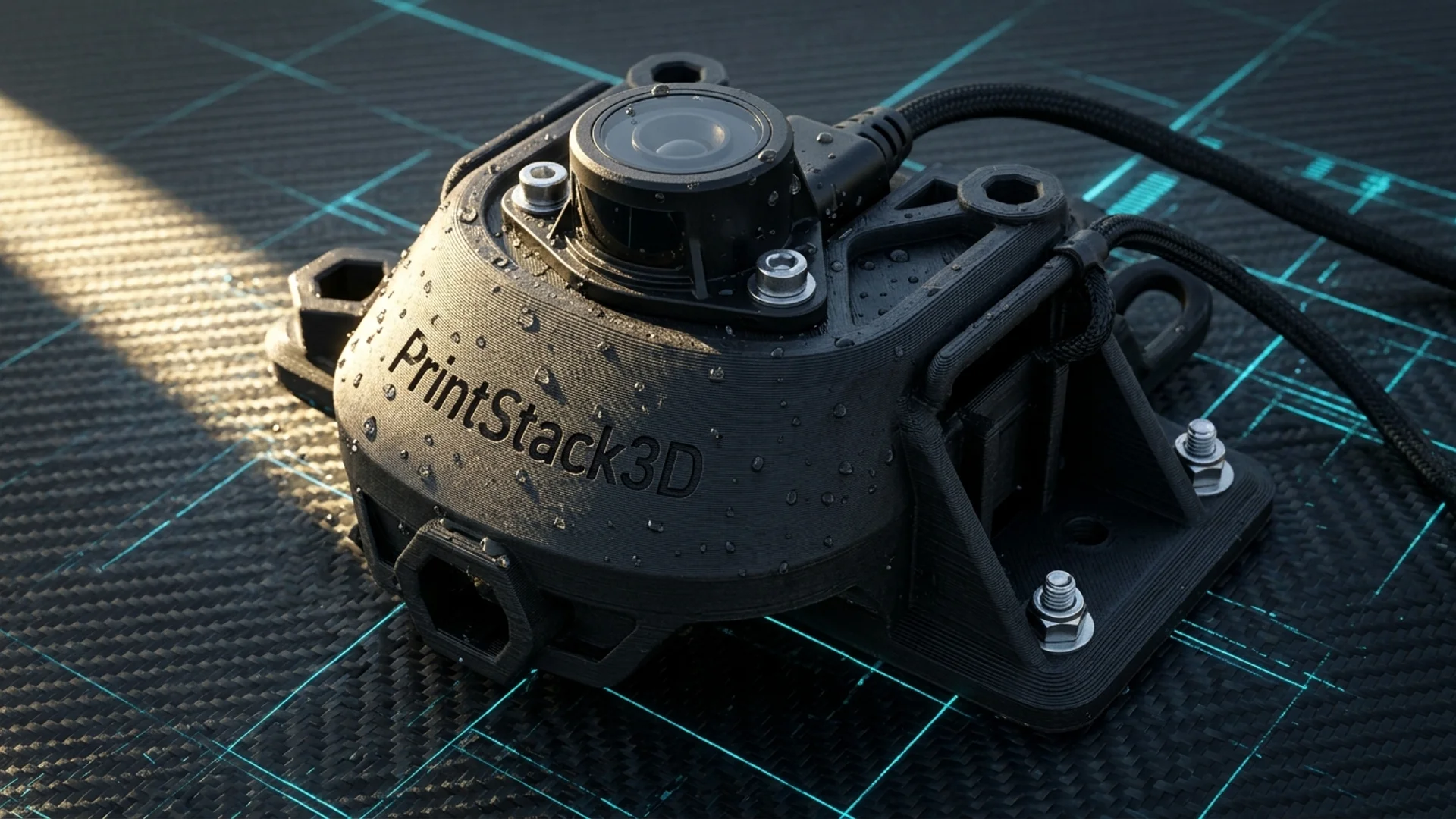
ASA vs PETG for Outdoor & Automotive Hardware: The Ultimate UV & Weathering Guide
PrintStack3D · 2026-08-18
The Challenge of Outdoor Environments for 3D Printed Parts
Designing physical 3D printed components for prolonged outdoor exposure—such as solar panel brackets, agricultural IoT sensor housings, marine fittings, or automotive exterior accessories—presents harsh environmental challenges.
Standard prototyping filaments quickly degrade when subjected to sunlight and thermal cycles:
- PLA (Polylactic Acid): Warps rapidly when ambient temperatures or direct sunlight push part temperatures above 55°C. Furthermore, UV radiation breaks down polymer chains, turning parts brittle within months.
- Standard ABS: While heat resistant up to 85-95°C, unprotected ABS yellow-discolors and micro-fractures under ultraviolet (UV) radiation due to photo-oxidation of its butadiene rubber phase.
To achieve multi-year outdoor durability, hardware engineers turn to two primary additive polymers: PETG (Polyethylene Terephthalate Glycol) and ASA (Acrylonitrile Styrene Acrylate).
Chemical Structure: Why ASA and PETG Resist UV and Weather
Acrylonitrile Styrene Acrylate (ASA)
ASA is engineered specifically as a UV-resistant alternative to ABS. While ABS uses butadiene rubber (which contains UV-vulnerable double bonds), ASA replaces butadiene with an acrylic ester elastomer. This synthetic modification provides immunity to UV degradation, preventing yellowing, chalking, and loss of tensile strength even after years of direct sunlight exposure.
Polyethylene Terephthalate Glycol (PETG)
PETG is a glycol-modified polyester. Its aromatic ring structure gives it inherent resistance to UV radiation and moisture absorption. PETG does not absorb water easily and resists environmental stress cracking when exposed to rain, salt water, and dilute chemicals.
Head-to-Head Technical Comparison: ASA vs PETG
| Mechanical & Thermal Property | PETG | ASA | Winner / Advantage |
|---|---|---|---|
| Heat Deflection Temp (HDT @ 0.45 MPa) | ≈70-73°C | ≈95-100°C | ASA (Crucial for dark automotive parts) |
| UV & Weathering Resistance | Good (Minor fading over 3+ years) | Excellent (Zero degradation over 5+ years) | ASA |
| Impact Strength | High (Ductile failure) | High (Tough & resilient) | Tie |
| Chemical Resistance (Fuels/Oils) | Excellent (Resists IPA, oils, dilute acids) | Moderate (Soluble in acetone, sensitive to aromatics) | PETG |
| Printability & Dimensional Stability | Easy (Low warping, no chamber required) | Medium (Requires heated enclosure, 90-110°C bed) | PETG |
| Surface Finish & Post-Processing | Glossy / Semi-gloss | Matte finish (Can be acetone vapor-smoothed) | ASA (Matte OEM appearance) |
When to Choose PETG for Outdoor Projects
PETG is the optimal choice when:
- Parts Are Exposed to Oils, Solvents, or Fuels: PETG's chemical inertia makes it ideal for marine engine bays, fuel filler caps, and chemical dosing equipment.
- Budget and Speed Are Priorities: PETG prints easily without warping on large build volumes, reducing production cost.
- Moderate Temperature Climates: For enclosures installed in shaded environments or moderate climates where temperatures stay under 65°C.
When to Choose ASA for Heavy-Duty Outdoor & Automotive Use
ASA is mandatory when:
- Direct High-Temperature Sunlight Exposure: Dark-colored brackets installed on vehicle roofs, solar arrays, or black asphalt surfaces can easily reach 80°C in summer. ASA maintains structural integrity where PETG softens.
- OEM Automotive & Aftermarket Components: ASA's natural matte surface finish closely matches factory injection-molded automotive trims, bumper inserts, and mirror housings.
- Long-Term Architectural & Marine Installations: For permanent outdoor sensor housings, antenna mounts, and weatherproof electrical junction boxes rated for 5+ years of continuous weather exposure.
DFAM Best Practices for Weatherproof 3D Prints
To ensure your ASA or PETG parts remain watertight and structural outdoors:
- Increase Wall Loop Count: Specify at least 4 to 6 perimeter wall loops (1.6 to 2.4 mm wall thickness). This prevents moisture ingress between infill cavities.
- Optimize Infill Patterns: Use 3D infill patterns like Gyroid or Cubic at 25-40% density to distribute thermal expansion stress uniformly in all directions.
- Design Drain Holes: Prevent standing water buildup in internal cavities by adding subtle Ø3 mm drainage channels at the lowest geometric point.
Manufacture Outdoor-Grade Parts with PrintStack3D
PrintStack3D provides high-precision printing in industrial ASA and PETG materials, ensuring your outdoor hardware survives extreme weather conditions.
For help choosing the right material for your project, see our filament guide or browse the materials we print.
Frequently Asked Questions
Which filament is best for permanent outdoor parts — ASA or PETG?
ASA is the best choice for parts in direct sunlight: it resists UV degradation for years without yellowing or embrittlement. PETG is fine for shaded or short-term outdoor use but fades and loses impact strength over time.
Can PETG survive outdoors?
Yes, for moderate exposure. PETG holds up well in shade or mild climates, but in full sun it can yellow and embrittle within 6–12 months. For multi-year sun-exposed parts, choose ASA.
Can PrintStack3D print ASA and PETG parts for me?
Yes — upload your model and order ASA or PETG parts with an instant quote through our online ordering flow.