3D Print Infill: Patterns, Density & Strength Guide
PrintStack3D · 2026-05-08
calibrated Strength.
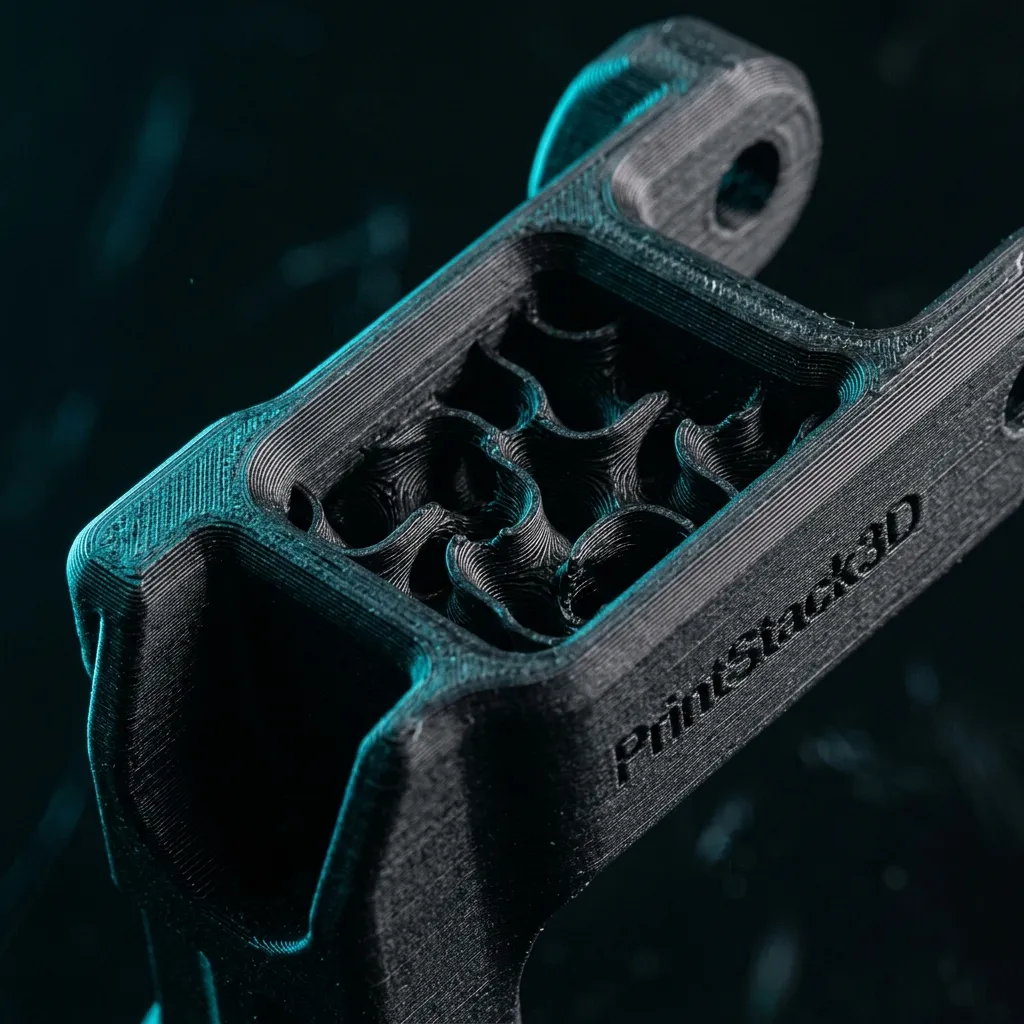
In 3D printing, what's on the inside matters just as much as the surface. The internal structure of a print, known as "infill," determines how strong, heavy, and flexible your part will be. Understanding the balance between infill density and pattern is key to creating precision-engineered parts.
Need this printed? Get an instant price for your model — upload it in the configurator with a free account.
Infill Density: Finding the Sweet Spot
Infill density is expressed as a percentage, where 0% is hollow and 100% is completely solid. Most functional parts don't need to be solid; in fact, a 100% solid part is often less efficient and more prone to warping.
- 0-15%: Ideal for decorative models where weight and speed are priority.
- 20-40%: The standard for functional parts, offering a great balance of strength and material usage.
- 50-100%: Reserved for high-stress mechanical components or parts requiring significant weight.
Choosing the Right Pattern
Not all patterns are created equal. The geometry of your infill dictates how forces are distributed through the part.
Popular Infill Patterns:
- Grid / Rectilinear: Fast to print and strong in two dimensions. Great for general-purpose parts.
- Gyroid: The modern favorite. It provides equal strength in all directions (isotropic) and allows for excellent liquid drainage if needed. Plus, it looks stunning.
- Honeycomb: Extremely strong and rigid, though it takes longer to print.
- Lightning: Perfect for decorative pieces; it only adds support where it's needed near the top surfaces, saving massive amounts of material.
Speed vs. Performance
Choosing a complex pattern like Gyroid or Honeycomb increases the printing time because the print head has to make more intricate movements. However, for functional parts that will face mechanical stress, the performance gain is worth the extra time.
Summary
| Pattern | Best For | Structural Property |
|---|---|---|
| Grid | General use | High compression strength |
| Gyroid | Functional parts | Uniform strength (Isotropic) |
| Lightning | Decorative models | Lowest material usage |
| Honeycomb | High-stress parts | Maximum rigidity |
At PrintStack3D, we automatically optimize infill patterns based on your project requirements to ensure the perfect balance of precision and performance. Upload your STL or 3MF and we'll handle the calibration.
Frequently Asked Questions
What is the strongest infill pattern for functional 3D prints?
Gyroid and Cubic are the premier patterns for engineering parts because they distribute mechanical loads isotropically across all three axes (X, Y, and Z) without crossing paths.
Does 100% infill make a part significantly stronger than 25% infill?
Rarely. Above 40–50% infill, print time and part weight skyrocket with diminishing structural returns. Increasing perimeter wall count (from 2 to 4 walls) boosts bending stiffness much more efficiently.
What infill density should I select when ordering at PrintStack3D?
Select 10–15% for visual prototypes and architectural models, 20–25% for everyday brackets and enclosures, and 40%+ for heavy-duty jigs and load-bearing mounts.